The Financial Investment Income Tax (FITT) Explained: Controversy, Pros and Cons
4 min read · · Korean original
Contents 4
The Financial Investment Income Tax has become a hot topic of debate among stock investors lately. What is it, and what are its pros and cons? Let's go through them one by one.

Key Points of the Financial Investment Income Tax
In Korean, it's called 금투세, short for "Financial Investment Income Tax." The core idea is to tax the combined profits earned from financial investments. You might be wondering why a tax that didn't exist before is suddenly being created.
The tax was first seriously discussed under the Moon Jae-in administration. In the current financial market, gains from stocks and derivatives are taxed as capital gains, bonds are not taxed, and gains earned through funds are taxed.
So even though all of these are returns on capital invested in financial products, there was no unified way of taxing them. In principle, the Financial Investment Income Tax aims to treat the gains from all financial products as a single type of income and tax them together.
What happens then? Let's say I earn KRW 100 million from overseas stocks and lose KRW 200 million on funds. In reality, I've lost KRW 100 million overall, but the two are calculated separately, so I still have to pay tax on the KRW 100 million gain from overseas stocks.
Once the Financial Investment Income Tax is introduced, however, I've made a loss overall, so I don't have to pay any tax. Looking at it this way, the tax may seem like a good thing. Since we're on the subject, let's start with the pros.
Pros of the Financial Investment Income Tax
One of the biggest advantages of introducing the tax is that, as in the example above, you don't pay tax when you've made a loss overall. Above all, the biggest advantage is that losses can be carried forward for 5 years.
Right now, gains and losses are reset every year, but once the tax takes effect, gains and losses accumulate over 5 years. In other words, if you take a big loss this year, you won't have to pay tax on future gains up to that amount.
Cons of the Financial Investment Income Tax
From that perspective alone, it might seem good for the tax to take effect. But the Financial Investment Income Tax is a brand-new tax that didn't exist before. That is its critical drawback.
Currently, gains on domestic stocks are tax-free unless your holdings exceed KRW 1 billion. In other words, under current law, most individual investors don't pay any tax on their gains.
However, once the tax takes effect, annual gains above KRW 50 million will be taxed at 20%. So if you make a KRW 50 million gain, KRW 10 million of it goes to tax. And if your gains exceed KRW 300 million, the rate rises to 25%.
On top of that, for overseas stocks, unlisted stocks and derivatives, tax applies from KRW 2.5 million in gains. It's practically telling you not to invest in them at all.
Final Summary of the Financial Investment Income Tax
Now let's wrap things up. The Financial Investment Income Tax combines all of an investor's financial investment income and taxes it together. Overall, since it introduces a new tax, it does work against investors.
That said, if you mainly invest in domestic stocks or funds, you won't have to pay any extra tax unless your gains reach KRW 50 million a year (with gains and losses carried forward cumulatively), so there's no need to worry too much.
However, if you make more than KRW 50 million in gains from domestic stocks, or more than KRW 2.5 million a year from overseas stocks or derivatives, you'll be subject to the Financial Investment Income Tax and will have to pay much more tax than before.
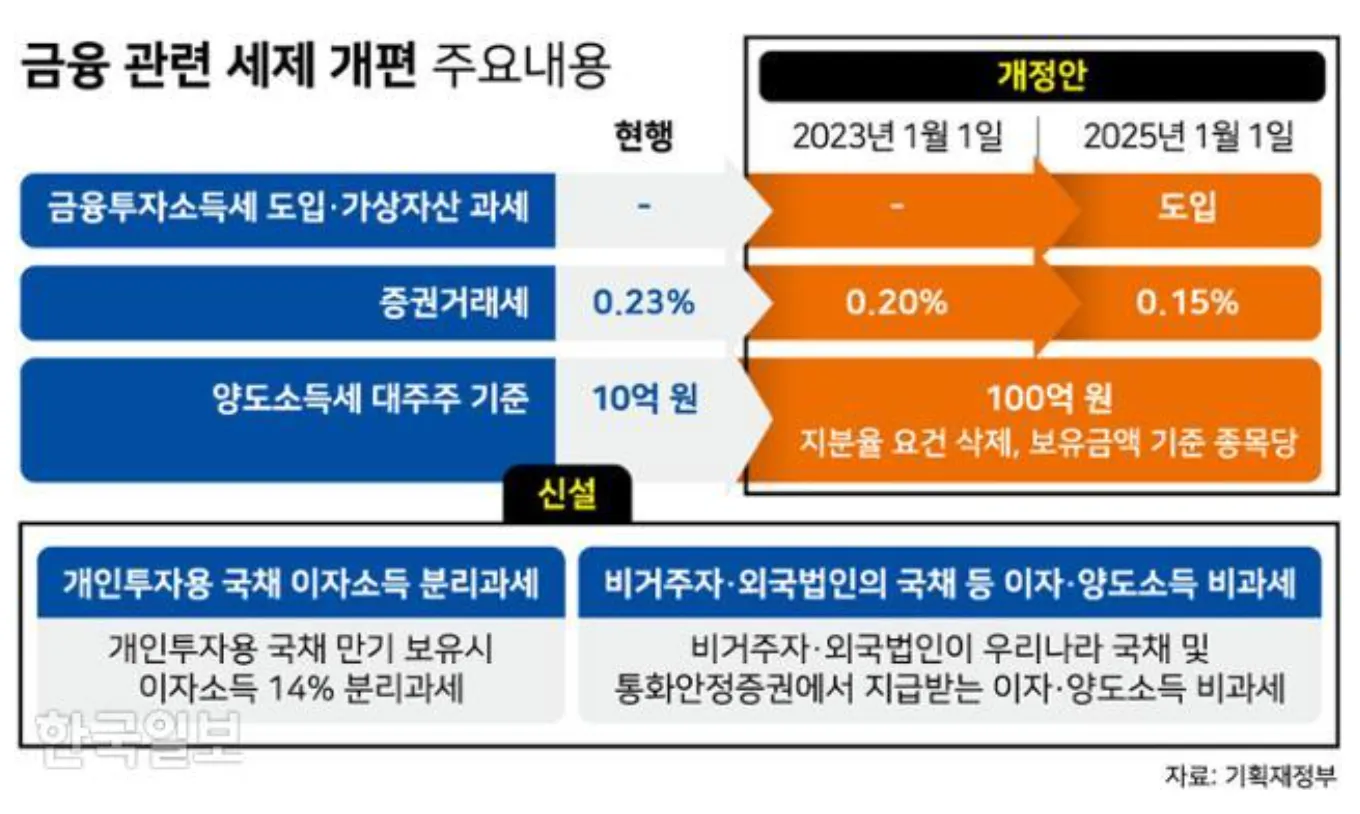
Public opinion seems to lean more toward opposing the tax. The concern is that once it takes effect, investors may end up having to pay tax, and the Korean stock market, which is already struggling, will slump even further.
In fact, when Taiwan announced a capital gains tax on stocks in 1988, stock prices fell 30% within a month. Amid fierce protests from investors, the tax was withdrawn just a year later. That covers the key concepts and the pros and cons of the Financial Investment Income Tax.