Everything You Need to Know About Bitcoin
8 min read · · Korean original
Contents 12
Bitcoin is a virtual asset that runs on a decentralized database called a blockchain. Bitcoin network transactions are recorded on a public ledger and verified by a network of nodes located around the world. Because Bitcoin is transparent and permissionless, it has become popular as an alternative to the traditional financial system.
What Is Bitcoin?
Bitcoin is a digital form of cash. However, unlike fiat currency issued by governments, there is no central bank controlling it. Instead, the Bitcoin financial system is run by countless computers distributed around the world. Anyone can join the Bitcoin ecosystem by downloading open-source software.
Bitcoin was first announced in 2008 and first launched in 2009. As the world's first virtual asset, the Bitcoin network allowed users to send and receive a digital currency called (b or BTC).
Bitcoin's three biggest features are that 1) it is censorship-resistant, 2) double spending is impossible, and 3) it can be traded freely anytime, anywhere.
What Are the 5 Key Features of Bitcoin?
1. Decentralization
Bitcoin runs on a decentralized public blockchain. This means no central authority controls Bitcoin. Instead, a network of computers called nodes verifies transactions. Anyone can also join the network and contribute to its security.
2. Permissionlessness
Anyone with an internet connection can join the Bitcoin network without permission from a central authority. With Bitcoin, you can send and receive payments with anyone on the network, regardless of location or identity. Because of this, Bitcoin is especially popular in places where access to the traditional financial system is limited or nonexistent.
3. Limited Supply
Bitcoin's maximum supply is 21 million BTC. This is hard-coded into the Bitcoin protocol, so there will be at most 21 million bitcoins in circulation. The limited supply prevents inflation.
4. Transparency
Every Bitcoin transaction is recorded on a public ledger that anyone can view. In other words, everyone can check the amount of bitcoin as well as the addresses of the sender and the recipient.
In the traditional financial system, banks and financial institutions manage these records, and the general public can't easily view them. The records are also stored and managed on the servers of centralized institutions.
5. Divisibility
Bitcoin can be divided into small units called satoshis, each equal to one hundred-millionth of a bitcoin. This means that even if the price of Bitcoin becomes very high, you can still transact with very small amounts of bitcoin.
How Does Bitcoin Work?
Let's say Changpeng is sending funds to Punk. Changpeng doesn't send the funds the usual way. Rather than handing Punk 1 dollar, it's similar to Changpeng writing "Changpeng gives Punk 1 dollar" on a sheet of paper that everyone can see.
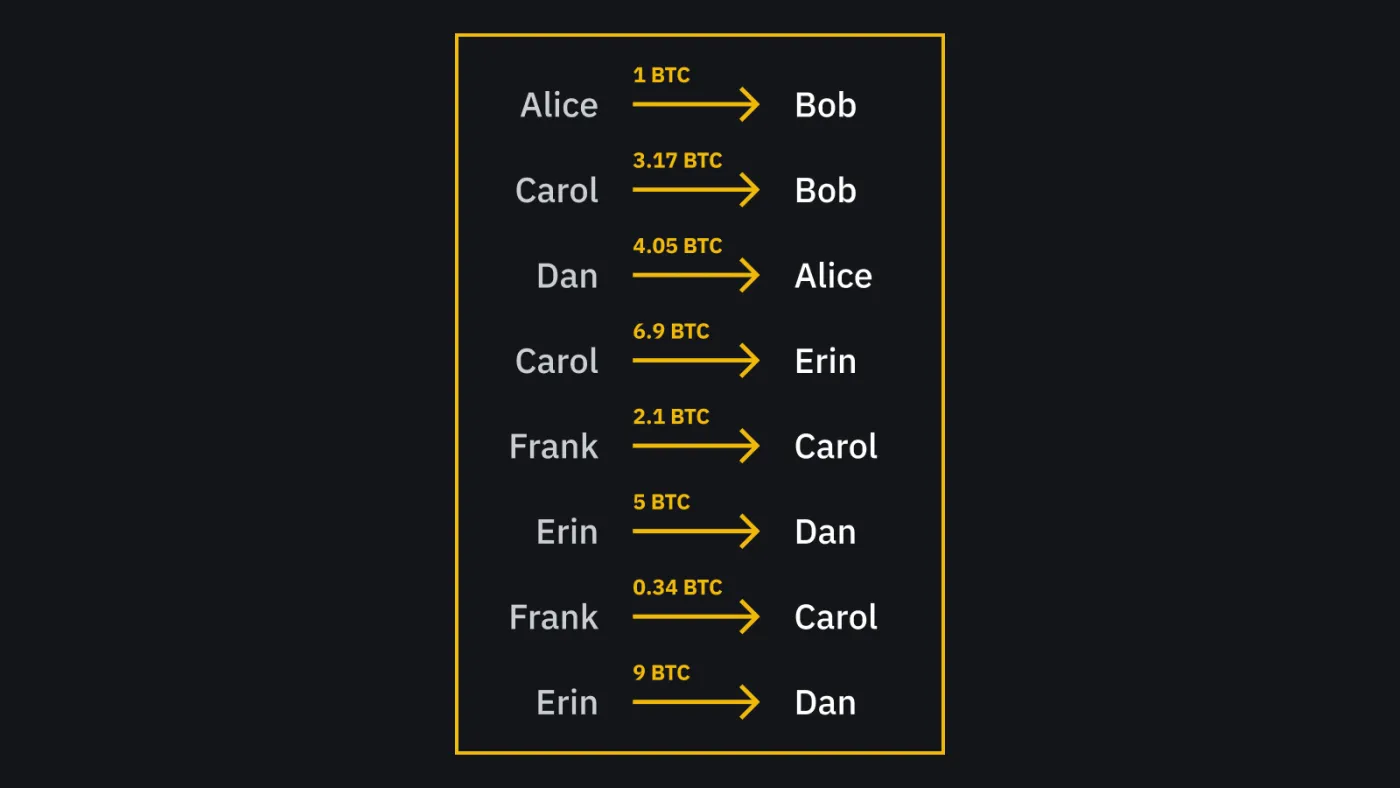
That sheet of paper is the database called the blockchain. Every network participant keeps an identical copy on their own device. Participants sync new information through their connections with one another.
To maintain the security and integrity of the blockchain, Bitcoin uses a consensus mechanism called Proof of Work (PoW). When a user sends a transaction, it is broadcast to the network, and other nodes known as "miners" verify it.
Miners compete to solve complex mathematical puzzles, which requires them to invest computing resources. The principle of Bitcoin mining is that the first miner to solve the puzzle adds a new block of transactions to the blockchain and receives BTC as a reward.
A miner who produces a valid block contributes to the security of the Bitcoin network and is rewarded for it. The reward consists of the transaction fees from the block and the block subsidy. Each time a block is mined, a set amount of bitcoin is added to the total supply.
Bitcoin's Proof of Work consensus mechanism is designed so that producing a block is very costly, while verifying a block stays cheap. If someone tries to record an invalid block on the blockchain and sync it across the network, the network rejects it and they lose their mining costs.
What Is Bitcoin Used For?
Bitcoin is mainly used as a digital currency and a store of value. Just like traditional money, users can pay with bitcoin online and offline, or send and receive it peer-to-peer (P2P). Because Bitcoin is a digital currency, it can be sent anywhere in the world.
Bitcoin is also used for more private transactions. Transactions are public, but they offer a degree of anonymity. In other words, you can transparently check transactions on the blockchain, but it's hard to confirm the real identity of the users.
Bitcoin is also traded on centralized exchanges such as Binance. Bitcoin investors expect its value to rise over the long term. Like gold and other commodities, Bitcoin has a limited supply, and since it's also decentralized, they see a bright future for it.
Why Is Bitcoin Valuable?
Bitcoin is decentralized, censorship-resistant, secure, and borderless. That makes it useful for international remittances and for individuals who want to send money without revealing their identity (which is exposed when using a debit or credit card).
Rather than spending bitcoin, many people prefer to hold it long-term in expectation of its value going up. Because of its finite supply, Bitcoin has earned the nickname "digital gold."
Some investors also see Bitcoin as a store of value. Because it is scarce and difficult to mine, Bitcoin is often compared to precious metals like gold and silver.
Because Bitcoin is liquid and can be used freely around the world, it is considered an ideal way to store wealth. Whether Bitcoin's value will really rise over time remains to be seen.
The History of Bitcoin
Bitcoin first became known in 2008, when Satoshi Nakamoto published the Bitcoin white paper titled "Bitcoin: A Peer-to-Peer Electronic Cash System." The Bitcoin white paper introduces the concept of a new digital currency that runs on a decentralized system, without relying on governments or central banking systems.
In January 2009, the Bitcoin protocol was released to the public for the first time, and the first Bitcoin transaction took place between Satoshi and a programmer named Hal Finney. In this transaction, Satoshi sent 10 BTC to Finney.
After that, more people learned about Bitcoin and began joining the network. The Bitcoin network, which works without any central authority or intermediary, became very popular within a small community.
Bitcoin Pizza Day marks the first time Bitcoin was used as a means of payment in a real transaction. On May 22, 2010, a programmer named Laszlo Hanyecz paid 10,000 bitcoins for two pizzas. It was a day that made new history for Bitcoin, and many people celebrate May 22 every year as "Bitcoin Pizza Day."
Who Is Satoshi Nakamoto?
Satoshi Nakamoto's identity remains a mystery. Satoshi could be an individual or a group of developers from anywhere in the world. Although the name is Japanese, many people believe Satoshi is from an English-speaking country because of their fluent English.
Did Satoshi Invent Blockchain Technology?
Interestingly, Satoshi never used the term "blockchain" in the white paper. Bitcoin combines several technologies that had been in use for a long time, and blockchain technology is one of them.
The first use case of immutable blockchain data dates back to the early 1990s, when Stuart Haber and W. Scott Stornetta proposed a system for timestamping documents. Like today's blockchains, they used cryptography to protect data and prevent tampering.
What Is Bitcoin's Total Supply?
According to the Bitcoin protocol, the maximum supply is capped at 21 million. As of 2023, more than 90% of all BTC had been mined, but mining the rest will take over 100 years. This is because of periodic events known as halvings, which gradually reduce the mining reward.
What Is the Bitcoin Halving?
The Bitcoin halving is the process that cuts the rate at which new bitcoins are created in half. More precisely, it refers to the periodic halving event that reduces the block reward given to miners.
The most recent Bitcoin halving took place in May 2020, and the next one is expected about four years later, in 2024. Halvings happen roughly every four years.
The Bitcoin halving is at the core of Bitcoin's tokenomics, making bitcoin progressively harder to mine at a predictable pace. This controlled inflation rate is one of the key differences between Bitcoin and traditional fiat currencies, which have unlimited supply.
Is Bitcoin Safe?
Some of the main risks associated with Bitcoin are hacking, theft, and 51% attacks. In a phishing scam, for example, hackers use social engineering techniques to trick users into revealing their login credentials or private keys Once a hacker gains access to a user's account or crypto wallet, they can transfer the victim's bitcoin to their own wallet.
Another way hackers steal bitcoin is through malware or ransomware attacks. Hackers infect a user's computer or mobile device with malware to gain access to the user's Bitcoin wallet. In some cases, hackers may use ransomware to encrypt a user's files and demand bitcoin to unlock them.
Beyond this, a 51% attack could also put the Bitcoin ecosystem at risk. In reality, however, this would be extremely difficult to pull off, and it is very likely never to happen.
Because Bitcoin transactions are irreversible and not controlled by any central authority, users have to keep their own bitcoin safe.
Ways to keep your bitcoin safe include using strong passwords, enabling two-factor authentication, and storing your bitcoin in a secure crypto wallet that hackers can't access. It's also important to download Bitcoin-related software only from trusted sources.
Another risk associated with Bitcoin is price volatility. The value of Bitcoin can swing sharply in a short period of time. So it can be a risky investment for anyone who isn't prepared for potential losses.
Wrapping Up
Bitcoin is a decentralized digital currency that has drawn a lot of attention in recent years. It was launched by Satoshi Nakamoto to offer an alternative to the traditional financial system. Bitcoin runs on a P2P network, so users can send and receive payments without intermediaries.
Although Bitcoin is a relatively new technology, it is already revolutionizing the way we think about money. As Bitcoin and other virtual assets keep evolving, it will be fascinating to watch them become a deeper part of our everyday lives.