
Money Supply M0, M1, M2, M3, and MZM Explained: What They Mean
4 min read · · Korean original
Contents 7
If you follow economic news, you'll often come across terms like M0, M1, M2, M3, and MZM. Basically, these are concepts for measuring the amount of money in the market. So what exactly do they mean?
- M0 = Cash issued by the central bank and supplied to the market
- M1 = M0 + demand deposits + freely withdrawable deposits
- M2 = M1 + time deposits + mutual funds + money market funds (...)
- M3 = M2 + large time deposits + institutional funds + large liquid assets (...)
- MZM = M1 + deposits + money market funds
Introduction
In the Middle Ages and early modern times, coins made of gold or silver were used as money. In other words, every transaction was carried out only with money issued by the government, without any credit. Today, we live in a capitalist society built on finance that is based on created credit. That is exactly why we distinguish between M0 and M3.
Once you understand M0, you can understand M1, and once you understand M1, you can understand M2. To put it simply up front, M0 through M3 and MZM are distinguished by the range of money each one includes. I've tried to explain it as simply as possible, so please read it through to the end.
M0
M0 refers to the money circulating in the market. Money officially issued by a country, such as the bills in your wallet and the coins in your piggy bank, is included in M0. That's why M0 is also called the monetary base.
M1
M1 is M0 plus banks' demand deposits (deposits that can be paid out at any time) and savings deposits that can be freely deposited and withdrawn. In other words, it's basic cash with basic credit added on top. M1 is also called narrow money.
How is M1 used? M1 was originally used to forecast GDP, inflation, prices, and so on. However, since there are now many more economic variables, it's hardly used these days. Below is the M1 data published by the Federal Reserve.
M2
M2 is called broad money. M2 is M1 plus time deposits (under $100,000), mutual funds, money market funds, and so on. Because M2 is considered an important indicator of future inflation, it's a monetary indicator that central banks track closely.
In the United States, the Fed used to release M1 and M2 every Thursday, but since April 2020 it has been publishing M2SL instead of M2. M2SL is almost the same as M2, the difference being that it's released monthly.
M3
M3 is M2 plus large time deposits, institutional funds, and large liquid assets. Traditional economists have used M3 to estimate the total money supply in the economy. M3 can be described as the broadest measure of a country's money. For reference, the Fed has not published it since 2006.
MZM
Finally, there's MZM. MZM stands for Money of Zero Maturity, meaning money that has no maturity and can be taken out and used at any time. Seen this way, it's quite similar to M1. MZM is M1 plus deposits and money market funds.
MZM is regarded as reflecting the flow of real-world payments better than M2 or M3, and it's increasingly the most widely used. In other words, it's currently the most commonly used monetary indicator.
Conclusion
So far, we've looked at M0, M1, M2, M3, and MZM. To sum it all up, it looks like the diagram below.
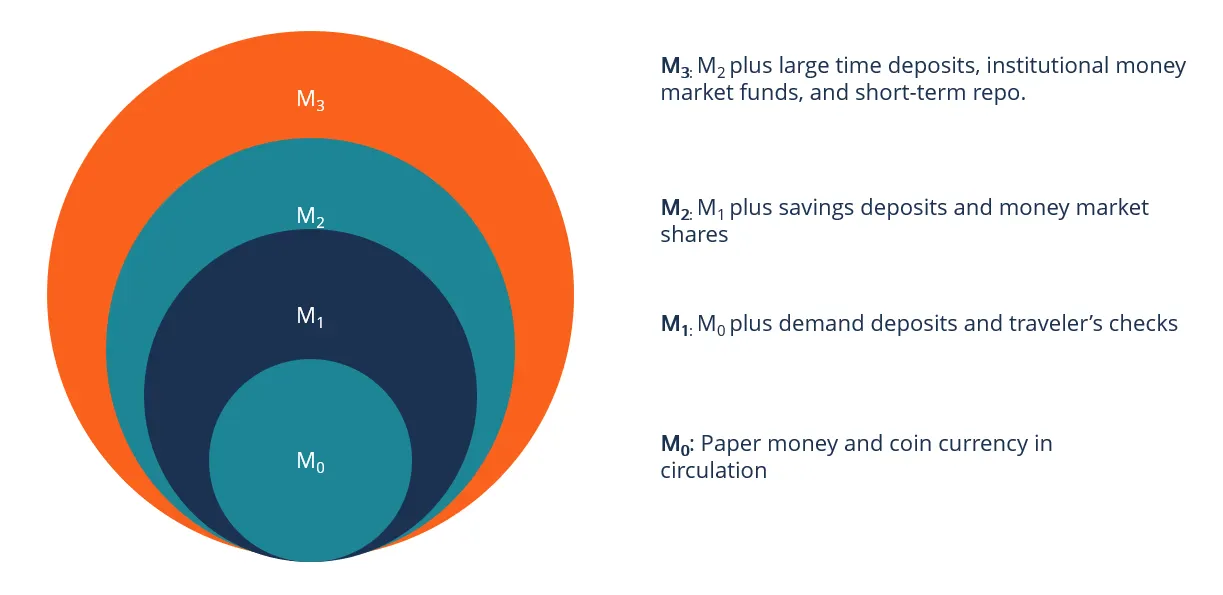
- M0 = Cash issued by the central bank and supplied to the market
- M1 = M0 + demand deposits + freely withdrawable deposits
- M2 = M1 + time deposits + mutual funds + money market funds (...)
- M3 = M2 + large time deposits + institutional funds + large liquid assets (...)
- MZM = M1 + deposits + money market funds