The ISA and Pension Account 'Double Taxation' Controversy and How to Resolve It
5 min read · · Korean original
Contents 5
The double taxation of overseas dividend income in ISAs (Individual Savings Accounts) and pension accounts has recently become a major issue. It directly affects anyone investing in overseas dividend stocks or ETFs.
Until now, taxes withheld abroad were partially credited against Korean taxes, but with this credit method abolished from 2025, investors' tax burden is expected to rise sharply.

In this post, we'll take a detailed look at the causes of the double taxation problem, the government's response, and a few tax-saving strategies investors can consider.
Double Taxation in ISA Accounts
An ISA is a tax-advantaged investment account in which part of your investment returns is tax-free or taxed at a low rate (9%). Previously, taxes withheld abroad were taken into account when taxing in Korea, so that the same income was not taxed twice.
For example, when you received dividends from a US dividend stock, the US first withheld 15% in tax, and Korea took this into account, lowering the additional Korean tax burden to around 1–2%.
From 2025, however, Korea also levies an additional 9% tax, separate from the tax already paid abroad (15%). As a result, the total tax burden rises to as much as 24%.
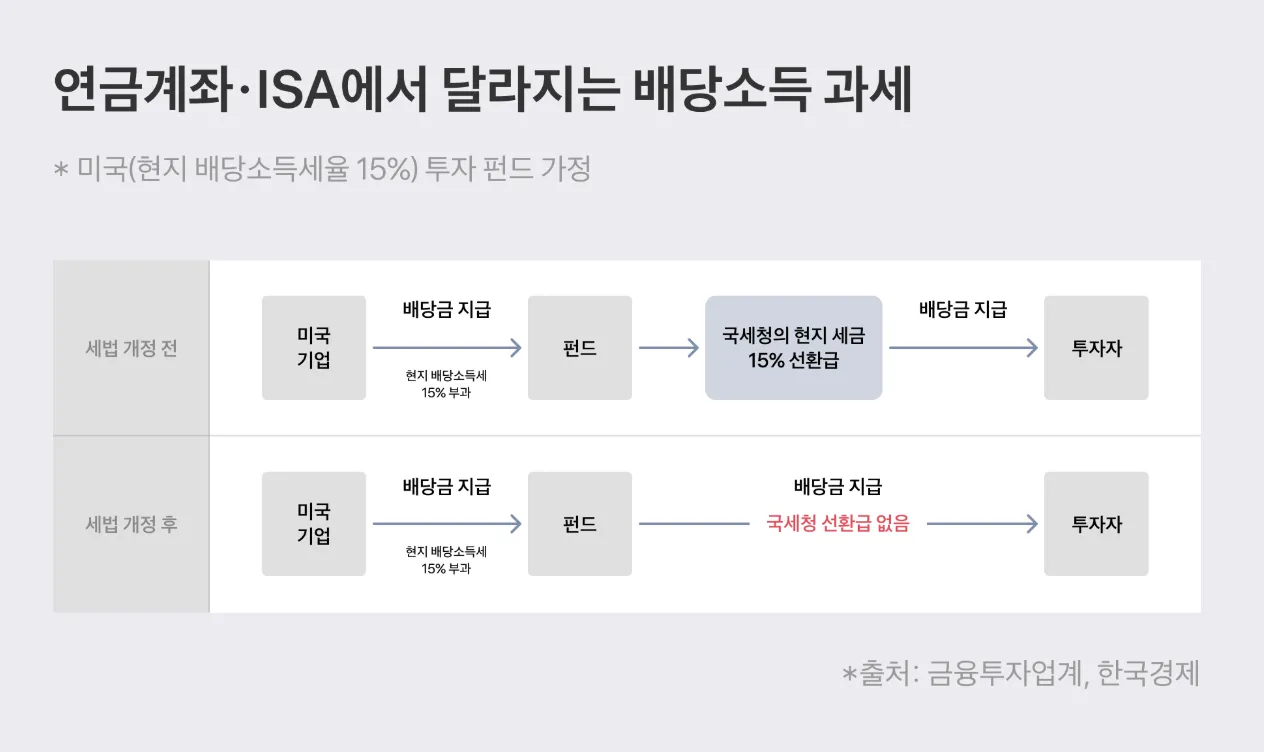
For example, if KRW 1,000,000 in dividends is paid, the US first withholds 15% in tax, so the investor receives KRW 850,000. Later, when the ISA account is closed, an additional 9% tax is levied on that dividend income, meaning an extra KRW 76,500 must be paid.
In the end, from the investor's point of view, the total tax burden used to be around 15–16%, but after the change it jumps dramatically to as much as 24–25%.
Double Taxation in Pension Accounts Too
Pension accounts (Pension Savings, IRP) offer tax deferral and are designed so that you pay tax on your investment returns only once, later, when you receive your pension. However, a double taxation problem has now arisen for dividend income from overseas dividend stocks and ETFs.
If the current situation is not resolved, whenever overseas dividend income arises, 15% will first be withheld abroad. Then, when you receive your pension, pension income tax (3–5%) is added on top. Previously, you only had to pay tax at the time you received your pension, but now the structure requires paying tax both when the dividend is paid and when the pension is received.
Ultimately, the pension investors receive will be significantly smaller than before. Because of this double taxation structure, long-term investment strategies using overseas dividend ETFs in pension accounts are increasingly likely to become difficult.
The Government's Solutions and Direction of Revisions
Direction of ISA Revisions
For ISA accounts, a plan is being discussed to recognize the tax already paid abroad (15%) and lower the Korean tax to around 0–1%. If this amendment passes, it is highly likely to take effect from July 2025.
In addition, a method of deducting foreign taxes paid on overseas dividend income in ISA accounts from Korean taxes would be applied, and an approach that treats the foreign withholding tax rate as 14% for the purpose of the tax credit is under review.
Direction of Pension Account Revisions
Unlike ISAs, pension accounts are structured for investing and accumulating returns over a long period, so a new tax law amendment that takes the netting of gains and losses into account is needed. Along with the ISA revision, the government is currently reviewing ways to resolve the double taxation problem in pension accounts, and a method of deducting taxes paid abroad from Korean taxes is being discussed.
Adjusting the tax rate on pension withdrawals or granting additional deductions is also being considered, as is a way to reduce the tax burden by netting gains and losses with other investment products (Korean and overseas stocks, ETFs, etc.) within the pension account.
Strategies Investors Can Consider
Because of the double taxation of overseas dividend income in ISAs and pension accounts, some investors are considering new alternatives. So what investment strategies are there?
First, you can adjust your portfolio toward Korean dividend ETFs or high-dividend Korean stocks instead of overseas dividend stocks. For Korean dividend stocks, you only pay the 15.4% dividend income tax, and there is no double taxation problem like with overseas dividend stocks.
You could also consider covered call ETFs, which generate returns from option premiums instead of dividends. The income from covered call ETFs is classified as other income rather than dividend income, so it is free from the double taxation problem.
Finally, since the ISA amendment is likely to take effect from July 2025, another option is to temporarily hold off on investing in overseas dividend ETFs within your ISA account until the amendment is finalized. Once it is finalized, it is highly likely to be adjusted so that the tax already paid abroad (15%) is recognized and the Korean tax is lowered to around 0–1%.
Closing Thoughts
The double taxation of overseas dividend income in ISAs and pension accounts is currently a heavy burden for investors. For ISAs in particular, an amendment is likely to take effect in July 2025, but for pension accounts a solution is not expected until 2026 or later, so it's worth adjusting your investment strategy carefully.
As overseas dividend ETFs in ISA accounts become less attractive, interest in alternative investment products such as Korean dividend stocks and covered call ETFs is growing. If necessary, it will be important to adjust your portfolio in line with these tax law changes and keep checking on the progress of the government's amendments.