What Is a Recession?
4 min read · · Korean original
A recession is a serious, prolonged downturn across the economy as a whole. A recession usually lasts six months or longer, and it is considered a recession when GDP declines for two consecutive quarters.
When a recession occurs, economic output, consumer demand, and employment decline. In the United States, indicators such as nonfarm payrolls, industrial production, and retail sales are used to determine a recession.
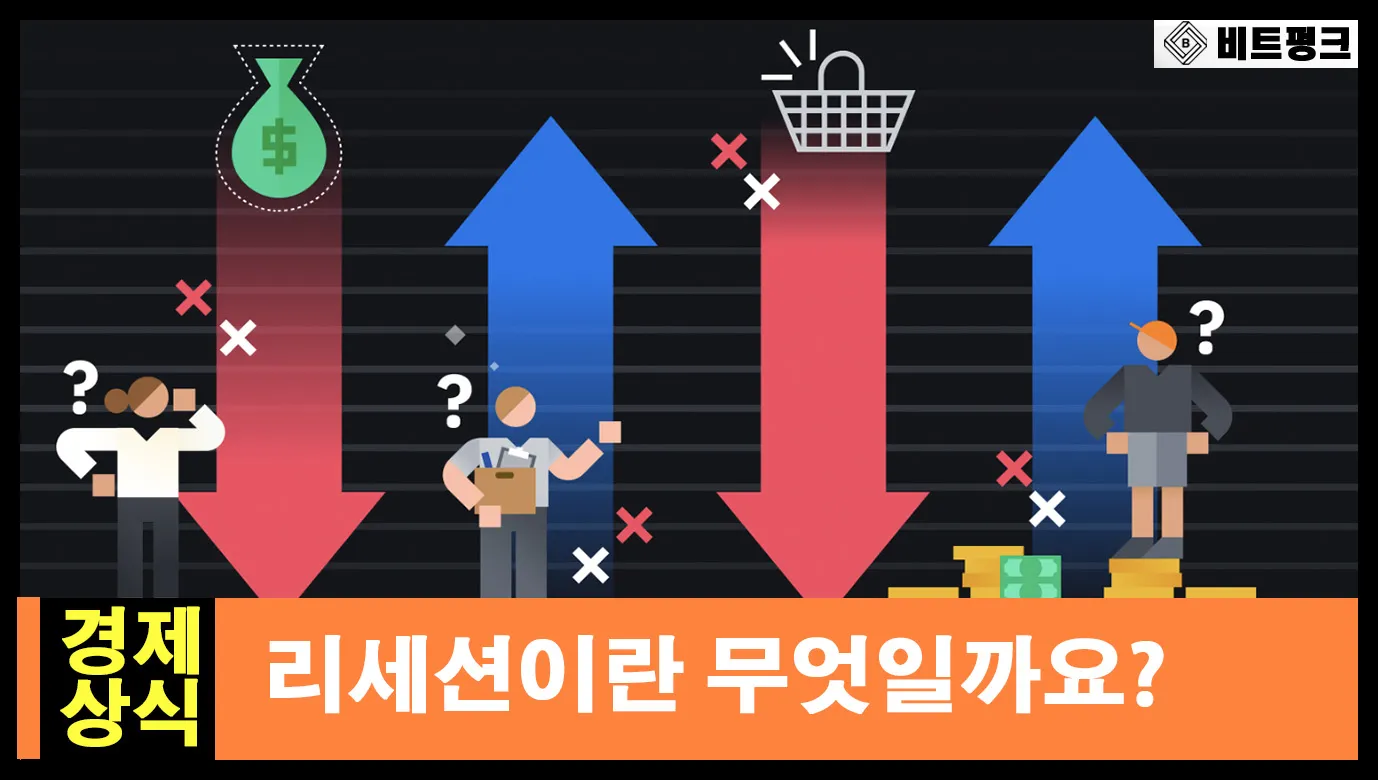
- A recession is a serious, prolonged downturn across the economy as a whole.
- A recession may last only a few months, but it can take years for the economy to recover to its previous level.
- Even after the economy recovers, unemployment can stay high for a while, so in practice the downturn can feel even longer.
- Countries around the world implement fiscal and monetary policies to control recessions.
The Meaning of a Recession
Economic growth follows the business cycle, repeatedly moving from its lowest trough to its highest peak. When the economy begins to contract, this is called a recession.
Since the Industrial Revolution, most countries have shown steady economic growth, and economic downturns have been regarded as exceptions. A recession is part of the business cycle: it resolves the imbalances built up by continuous growth and makes renewed growth possible in the future.
Recessions are a common phenomenon around the world, but in modern times their frequency and cycles have been getting shorter. According to the IMF, there were a total of 122 recessions between 1960 and 2007, and of these, 21, or about 10%, affected advanced economies.
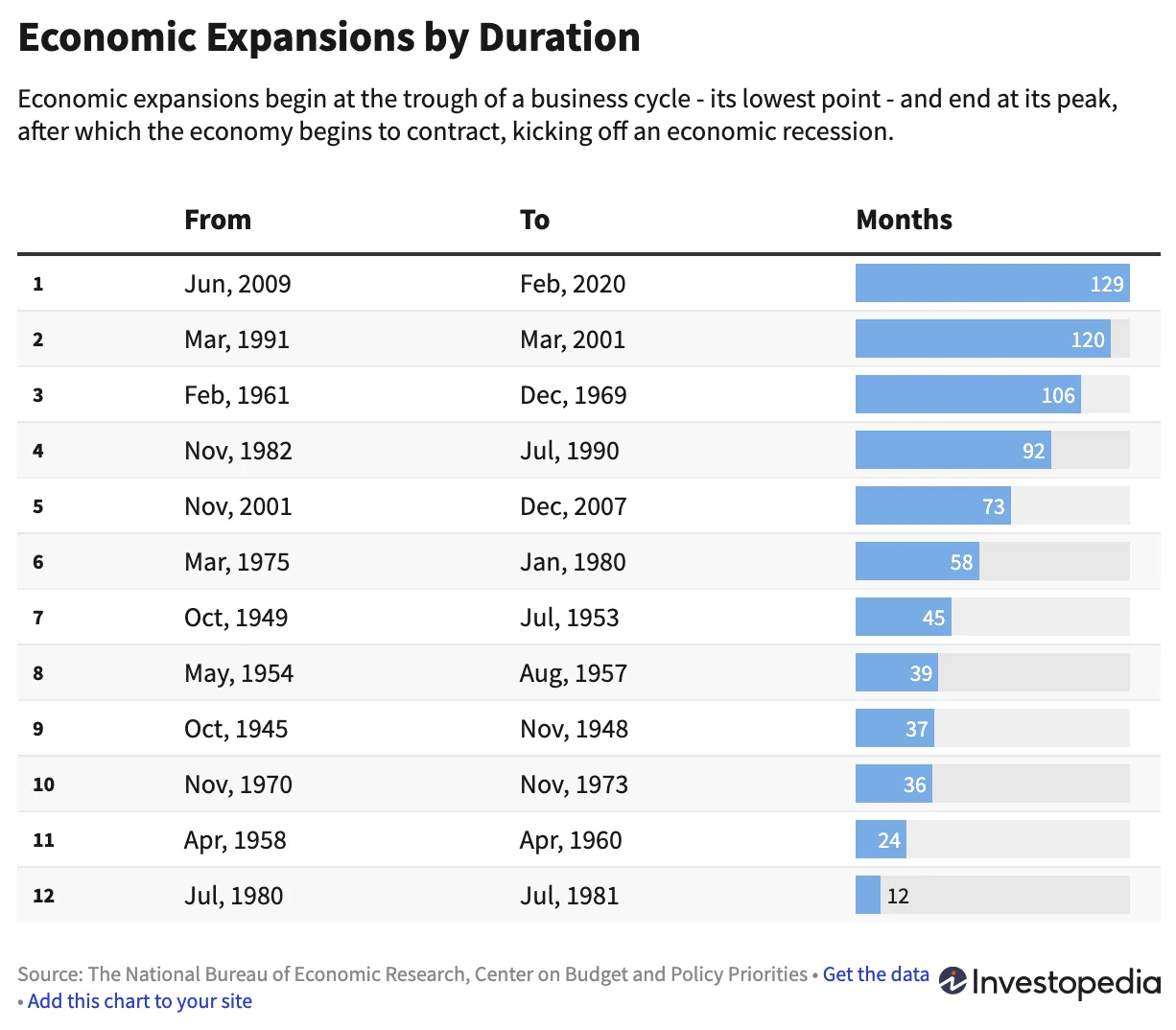
The table below shows periods of economic growth in the United States. You can see that over time, recession cycles have become shorter and periods of economic growth have become longer.
A recession means that this growth trend reaches its peak and then turns down sharply, which can lead to declines in economic output and employment. Asset markets such as stocks may also enter a bear market or downtrend.
Since the Great Depression, governments around the world have implemented fiscal and monetary policies to prevent recessions from turning into long-term economic slumps. Measures such as unemployment benefits, employment support, and interest rate cuts fall into this category.
Recession Signals
There is no single indicator that determines a recession. However, since 1955, recessions have frequently followed an inversion of the yield curve.
Long-term bonds generally offer higher yields than short-term bonds because investors have to bear risk for a longer period. In other words, a 10-year bond usually offers a higher yield than a 2-year bond. This is because the risk of its price falling due to inflation and interest rate changes is greater.
However, a yield curve inversion can occur, in which the yield on the 2-year bond rises above that of the 10-year bond. This happens because traders expect an economic downturn and interest rate cuts in the future.
Short-term interest rates fluctuate significantly depending on the Fed's rates and short-term expectations about monetary policy. When the Fed is expected to keep raising rates, the 2-year yield can rise above the 10-year yield.
In the United States, there have been 34 recessions since 1854, with the 2008 financial crisis, the double-dip of the 1980s, and the Great Depression of 1937 recorded as severe recessions. According to the IMF, a typical downturn can cause GDP to fall by about 2%, but in a severe recession it can fall by 5% or more. During the Great Depression, US economic output fell by 33%, stocks fell by 80%, and the unemployment rate reached 25%.
What causes a recession? There are many reasons, but the recession signals that appeared in 2022 were largely driven by a surge in oil prices caused by a geopolitical crisis. Because oil is central to economic activity, rising oil prices can increase production costs across the entire economy.
Investing During a Recession
How should you invest and respond during a recession? During a recession, it's a good idea to invest in companies with low debt, good cash flow, and a strong balance sheet. Alternatively, you can invest in stable products such as deposits or bonds to benefit from interest rate hikes. You should pay down debt quickly and look for ways to hedge against falling asset values. However, until the recession is completely over, it's best to avoid using leverage or speculating.
Above all, no one can know when a recession will end and the economy will start to recover. Also, even if the economy recovers from a recession, unemployment can remain high, so it may take longer than the indicators suggest for people to actually feel the recovery. That's why during a recession, you should prepare a careful and cautious long-term investment strategy.