What Is Stagflation?
5 min read · · Korean original
Contents 6
What is stagflation, and how does it affect the economy? Let's look at what causes stagflation and how it can be dealt with.
Stagflation Summary
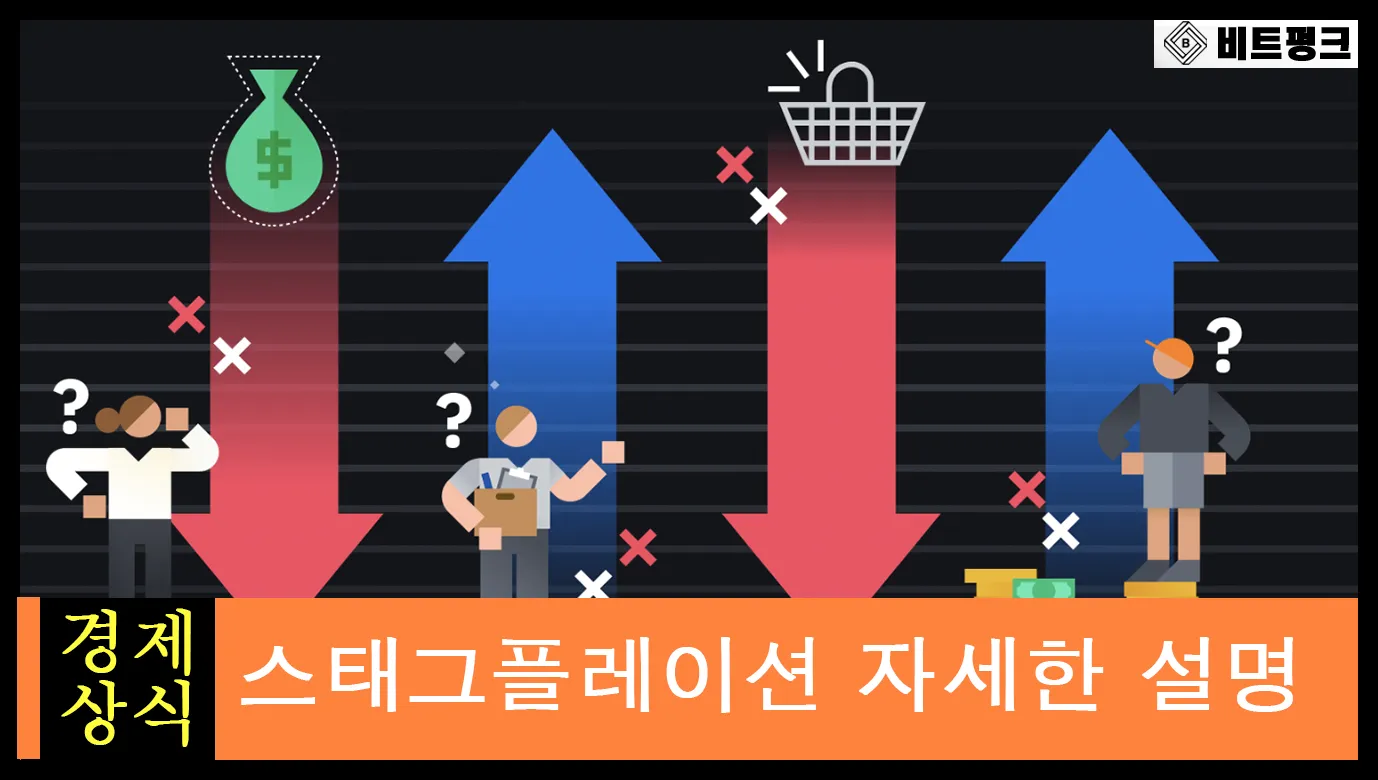
Stagflation refers to an economic situation in which an economic downturn or negative growth (recession) and rising prices (inflation) occur together with high unemployment. There are strategies for dealing with recession and with inflation, but these strategies tend to conflict with each other, which makes stagflation difficult to tackle.
Generally, economic stagnation or negative growth can be addressed by increasing the money supply so that businesses can borrow at lower cost (lower interest rates). An increase in the money supply can lead to higher employment and can effectively bring a recession under control.
In the case of inflation, economists and policymakers try to control it by reducing the money supply. By raising interest rates, which are the cost of borrowing money, they restrain lending to businesses and consumers. This reduces demand and curbs rising prices.
Stagflation, however, is the worst possible economic situation, in which recession and inflation occur at the same time. So what exactly is stagflation, and how can it be solved?
What Is Stagflation?
Stagflation is a concept first mentioned in 1965 by Iain Macleod, a British politician and Chancellor of the Exchequer. It is a combination of stagnation and inflation, and it describes a situation in which the economy shows negative growth while also experiencing high unemployment and high consumer prices (inflation).
The reason stagflation is hard to deal with is that the monetary policy used to address stagnation and the one used to address inflation each make the other problem worse. If not brought under control in time, stagflation can lead to a larger financial crisis.
What Causes Stagflation
There are various theories and views on the causes of stagflation, depending on schools of thought such as monetarism, Keynesianism and neoclassical economics. Let's look at a few examples.
- Conflicting monetary and fiscal policy
Central banks and related institutions, such as the US Federal Reserve, manage the economy through monetary policy. Governments also directly influence the economy through fiscal policy, namely spending budgets and taxes. However, when monetary policy and fiscal policy conflict, rapid inflation and slowing economic growth can result. Stagflation can occur when the money supply increases but consumer spending falls. For example, a government may raise taxes while, at the same time, the central bank carries out quantitative easing or cuts interest rates. In that case, the government ends up restraining economic growth while the central bank increases the money supply, which can lead to stagflation.
- The introduction of fiat money
In the past, major economies pegged the amount of their currency to gold through the gold standard. However, after World War II the gold standard was abolished, making a virtually unlimited supply of fiat money possible. This allows central banks to manage the economy more effectively, but it has also raised the risk of inflation.
- Rising supply costs
Stagflation can occur when the cost of producing goods and services rises sharply. In particular, when a supply shock hits the energy sector, consumers can suffer from rising oil and energy prices.
When the cost of producing goods increases and heating, transportation and other energy-related costs rise, the likelihood of stagflation increases.
How to Deal With Stagflation
Stagflation can be addressed through monetary and fiscal policy, but views on each approach differ depending on the school of economic thought.
- Monetarists
Monetarists (economists who believe that controlling the money supply is the most important thing) argue that inflation is the most urgent problem to solve.
Monetarists argue that the overall money supply should be reduced, which in turn should bring down the prices of goods and services. The problem, however, is that such a policy hinders growth. The growth issue is left as a problem to be solved later through improved monetary policy combined with fiscal policy.
- Supply-side economists
Other economists argue that the focus should be on the supply side of the economy, by cutting costs and improving efficiency.
They argue that controlling energy prices and providing subsidies for efficient investment and production would increase the economy's total supply, which would lower consumer prices and raise economic productivity, thereby reducing unemployment.
- Free-market economists
Some economists argue that stagflation, too, should be resolved according to the logic of the free-market economy. Consumers will not be able to afford inflation, and as a result prices will find stability through supply and demand. In this way, inflation will resolve itself automatically.
In addition, the free market will approach the labor market efficiently, which will also solve the unemployment problem. Despite this optimism, however, in reality there is no knowing how much time and cost it would take for stagflation to be resolved through free-market policies.
Stagflation and the 1973 Oil Shock
In 1973, the Organization of Arab Petroleum Exporting Countries (OPEC) banned oil exports to certain countries. This was a measure taken in response to support for Israel in the Yom Kippur War. As a result, the oil supply dropped sharply and oil prices soared. This led to a supply chain crisis and rising consumer prices, causing massive inflation.
Countries such as the United States and the United Kingdom had been cutting interest rates to stimulate economic growth. Low interest rates are a policy that encourages borrowing and generally leads to more inflation.
In the end, increased consumer spending due to rising oil prices was accompanied by pro-market policies at the same time, and when the oil shock hit, many Western countries ended up experiencing an economic downturn along with high inflation.
Conclusion
Stagflation generally refers to a situation in which inflation and negative economic growth occur together. Because the monetary and fiscal policies used to fight inflation and those used to fight negative economic growth tend to conflict, stagflation is extremely difficult to deal with. In other words, trying to control inflation slows economic growth, and trying to encourage economic growth can leave inflation out of control. Stagflation must therefore be addressed by taking into account the macroeconomic context and factors such as the money supply, interest rates, supply and demand, and the employment rate.