What Is a CFD (Contract for Difference)?
4 min read · · Korean original
Contents 3
Recently, the Korean stock market saw a massive sell-off, with some stocks hitting the daily lower limit several days in a row. Many wealthy investors, including the entertainer Lim Chang-jung, are reportedly involved, and suspicions of large-scale stock price manipulation are growing. Contracts for Difference (CFDs) were reportedly used in the process. So what is a CFD, and why has it become such a hot issue?

What Is a CFD (Contract for Difference)?
A CFD (Contract for Differences) is a (3) high-risk over-the-counter derivative in which (1) you do not actually own the stock and (2) the difference between the buy and sell amounts is settled in cash. It was first introduced in the UK and is also actively traded in Germany, Australia and elsewhere. In Korea, too, CFD trading volume has grown steadily since the eligibility requirements for individual professional investors were relaxed (changed from a balance of KRW 500 million at a financial institution, income of KRW 100 million or more, and assets of KRW 1 billion or more, to a balance of KRW 50 million at a financial institution, income of KRW 100 million or more, and assets of KRW 500 million or more).
The underlying assets offered through CFD derivatives consist of about 2,300 Korean stocks plus foreign stocks from markets such as the US and Hong Kong. You can open positions in both directions, buying or selling, and your profit or loss is settled by multiplying the price difference between your entry and exit points by the number of CFD contracts.
CFDs offer up to 2.5x leverage with a minimum margin of 40%, and you can take both long and short positions. They are similar to traditional futures trading, but like Bitcoin perpetual futures, they have no expiration date. In short, a CFD is essentially the stock market's version of a perpetual 2.5x leverage futures derivative.
To trade CFDs, you need margin. To cover potential losses, you must keep a maintenance margin of at least 80% of the initial margin. If your losses exceed the margin you deposited, your position may be forcibly liquidated, and you may even lose more than your principal.
The Mass Sell-Off from SG Securities CFD Accounts
In April 2023, eight stocks, including Samchully, Seoul City Gas and Daesung Holdings, plunged and hit the daily lower limit. These stocks kept hitting the lower limit for 3 to 4 consecutive trading days. As a result, about KRW 8 trillion in market capitalization vanished from those eight stocks in just one week.
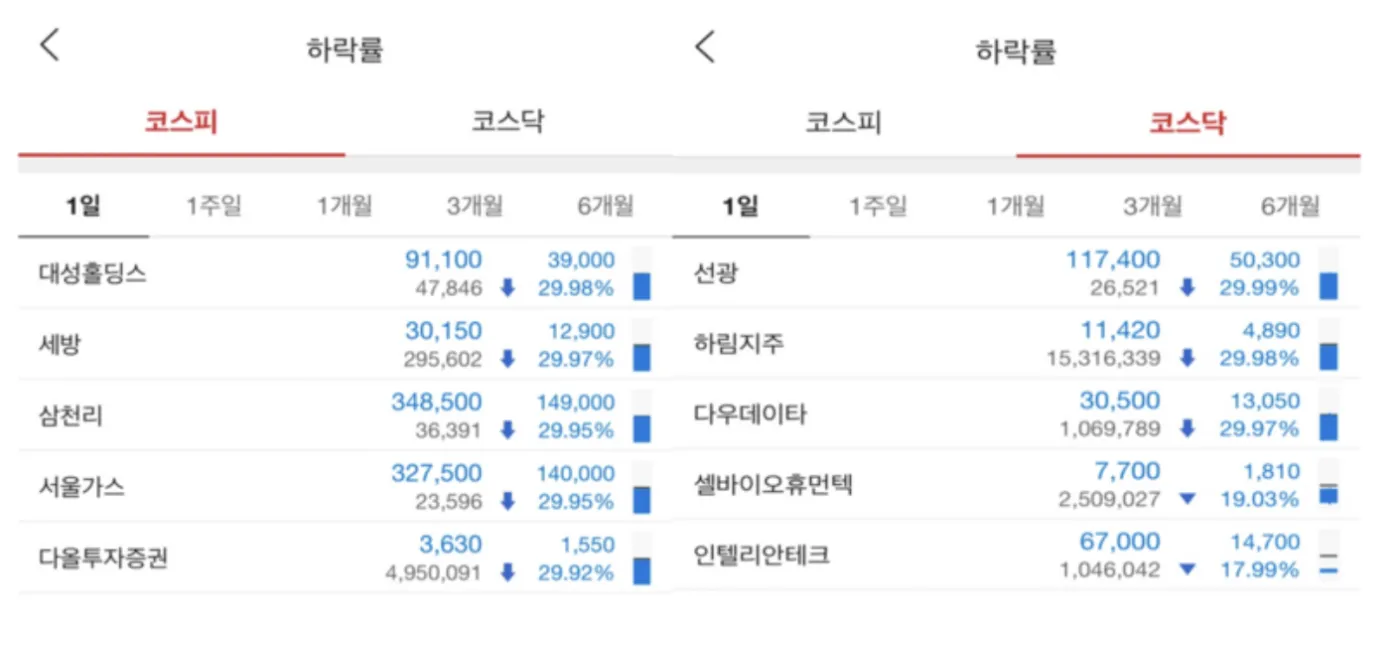
What these stocks had in common was a huge volume of CFD sell orders coming through SG Securities, a foreign brokerage. Financial authorities believe a stock manipulation ring used CFD accounts to manipulate share prices through matched trading. Matched trading is an unfair trading practice in which two or more people agree on a stock's price and volume in advance and then trade with each other to push the price up.
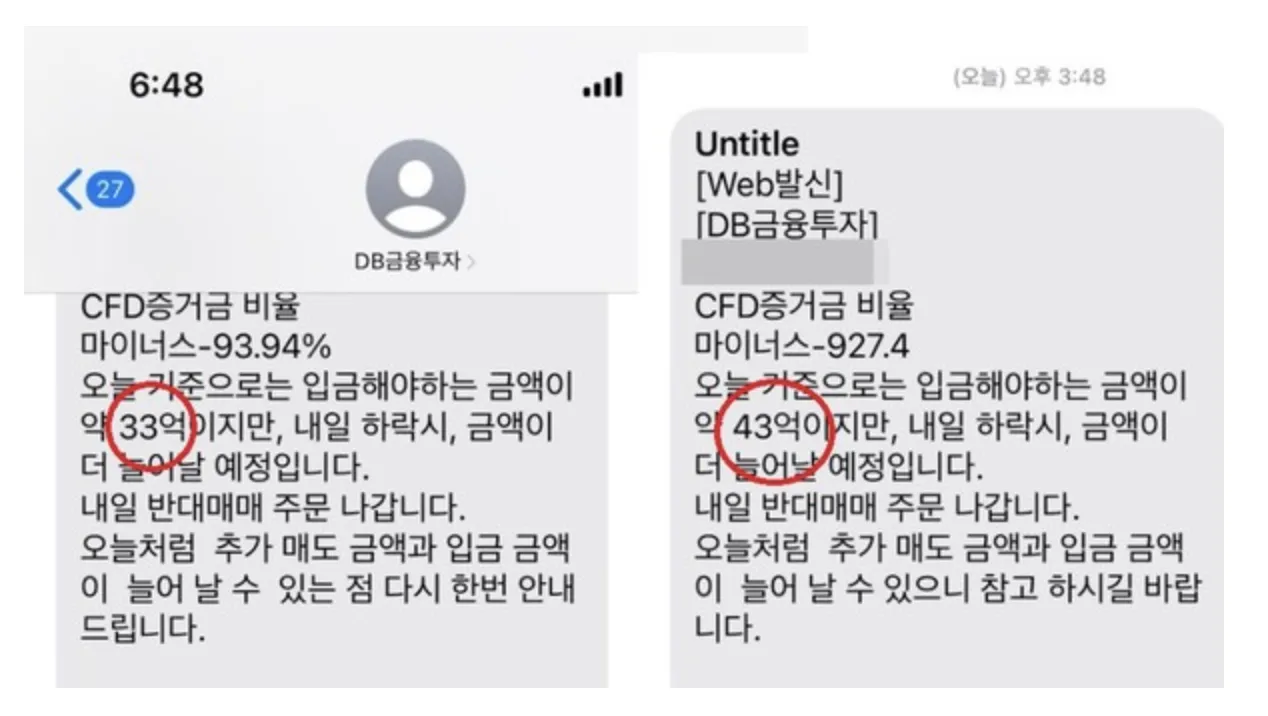
As the massive CFD sell-off poured in through SG Securities, retail investors also suffered heavy losses. Because of CFD account liquidations, some investors have ended up owing losses several times larger than their margin, and brokerages have temporarily suspended opening new CFD accounts and CFD trading. Below is a screenshot of losses captured from an online community. The losses are enormous, ranging from about KRW 3.3 billion to KRW 4.3 billion.
Wrapping Up
A CFD is a high-risk over-the-counter derivative that lets you speculate on the price movements of an underlying asset without actually owning the stock. With Korea's CFD eligibility requirements relaxed, trading volume among retail investors has grown sharply. However, if your losses exceed your margin, you face the risk of liquidation and may even have to pay the brokerage more than your principal, so you should be especially careful when using CFDs.