Berachain's Key Features and Popular DeFi Apps
7 min read · · Korean original
Contents 8
Hello, this is Bitpunk. Today we'll look at what Berachain is and what its key features are. We'll also look at Berachain's outlook and how to use BERA coin in DeFi.

What Is Berachain?
Berachain is an EVM-compatible Layer 1 solution that runs on Proof of Liquidity. Berachain is built on the Cosmos SDK. Put simply, it's a blockchain that can use Ethereum smart contracts as they are while also having the scalability of the Cosmos ecosystem.
Berachain runs on a new consensus mechanism called Proof of Liquidity (PoL). What does that mean? Until now, validators were people who held a lot of coins (Proof of Stake) or poured in computing power (Proof of Work).
On Berachain, the people who supply liquidity become validators. In other words, if you put money into the market and provide liquidity, you take on the role of a validator, and that's how the network's security and stability are maintained. And of course, the people who put in money receive rewards in return. Does that make sense so far?
The Core of Berachain: What Is Proof of Liquidity?
The concept of Proof of Liquidity may be a bit confusing. That's understandable, because Proof of Liquidity is a consensus mechanism that Berachain introduced for the first time. For example, on existing Proof of Stake blockchains like Ethereum or Solana, you could become a validator and earn rewards just by staking coins.
On Berachain, however, you have to provide assets directly to liquidity pools to become a validator. Let's first take a quick look at how it works. Here's how Proof of Liquidity works on Berachain.
- When users supply liquidity to a DeFi platform on Berachain, they receive BGT (Bera Governance Token).
- Holding BGT lets you vote in governance and take part as a validator.
- Once selected as a validator, you help protect the network and receive additional rewards.
- Since becoming a validator requires liquidity, liquidity naturally builds up within the network and security improves.
To sum up, on Berachain, the more liquidity there is, the stronger the network's security becomes and the more rewards can be earned. On top of that, this approach is emerging as an alternative that can solve a problem with existing Proof of Stake: a small number of whales monopolizing validator power.
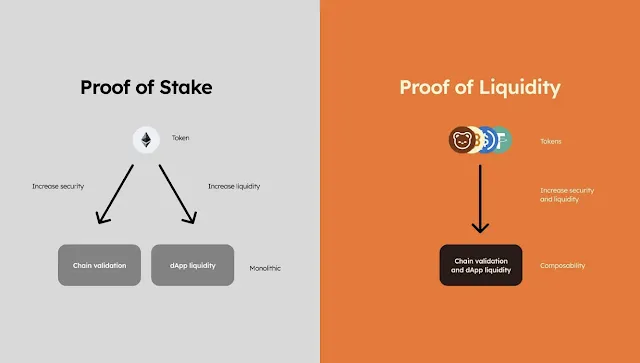
Take a look at the image above. In the case of Ethereum, you can become a block validator by staking ETH, but this is a separate process from the liquidity of dApps. As a result, block validators can dump the block rewards they receive every day onto the market.
On Berachain, however, chain validation and Proof of Liquidity are combined into one. In other words, block validators also need to keep supplying liquidity to effectively earn more rewards.
Isn't It the Same Thing in the End? Why Proof of Liquidity Differs from Proof of Stake
At this point, you might be thinking: in the end, doesn't Proof of Liquidity also let those who provide the most liquidity monopolize power? That's partly right and partly wrong. To explain, let's compare Proof of Stake and Proof of Liquidity a bit more closely.
In Proof of Stake, you can become a validator simply by holding a large amount. So if you buy a large amount of coins early on and stake them, you can keep monopolizing a large share of rewards without any real participation in the network.
In Proof of Liquidity, however, your contribution and rewards depend on how much you participate in liquidity pools, market making and DeFi. In other words, beyond simply holding and staking coins, ongoing contributions to the network make rotation and competition among validators possible.
To sum up, under Proof of Liquidity, just like Proof of Stake, some whales can still take relatively more rewards. The difference, however, is that Proof of Liquidity is an alternative model that can ease Proof of Stake's problem of persistent monopoly, and it can offer a more open and dynamic validator system.
Why Berachain Has Three Tokens
Usually, a blockchain has one main token. Berachain, however, operates with three tokens: $BERA, $HONEY and $BGT.
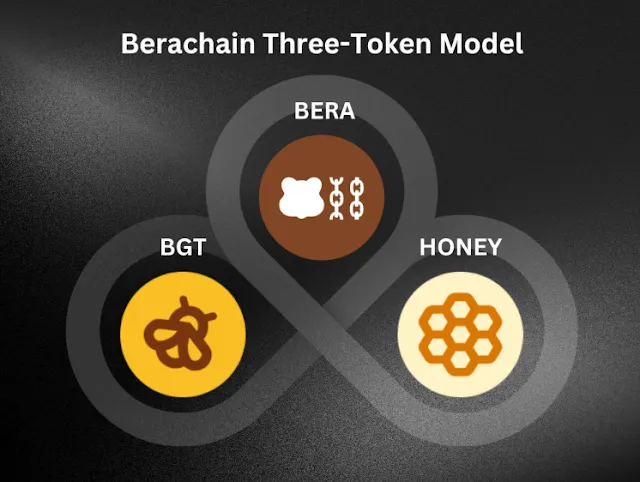
| Token | Function |
|---|---|
| BERA | The network's native token. Used to pay gas fees and for transactions. |
| HONEY | Acts as a stablecoin. Used for lending and trading in DeFi. |
| BGT | Reward token for supplying liquidity. Required for governance and validator activity. |
$BERA is a native token like ETH on Ethereum, $HONEY is a stablecoin used in DeFi, and $BGT is a reward token for the validator role and governance.
The reason for creating and running three separate tokens is to effectively implement the Proof of Liquidity described above. In particular, since the only ways to get $BGT are to provide liquidity or become a validator, it's drawing attention as a way to solve the monopoly problem of existing Proof of Stake.
How to Buy BERA Coin
BERA coin is currently listed on both Upbit and Bithumb in Korea. It's also listed on overseas crypto exchanges such as Binance, OKX and Bybit.
The only coin you can buy directly on exchanges is BERA coin, $BERA. Meanwhile, the stablecoin $HONEY can be minted on the Berachain Hub. As for $BGT, you can only earn it as a reward by participating directly in Berachain's Proof of Liquidity.
Berachain's Leading DeFi Projects
1) Kodiak
Kodiak is Berachain's decentralized exchange (DEX) and liquidity hub. It combines the AMM models of Uniswap V2 and V3 to build an optimized liquidity supply system. Through Kodiak, you can trade various assets on Berachain, supply liquidity and earn rewards. In the StakeStone Berachain event I introduced earlier, Kodiak points were also earned along the way.

2) Infrared
Infrared is Berachain's liquid staking hub. You can deposit Berachain assets into Infrared and receive the liquid governance token $iBGT as a reward. This lets you take part in validator activity or governance voting. It currently offers a fairly high APR, and if you're participating in Berachain's Proof of Liquidity, you can look for extra returns by using Infrared.

What's the Outlook for Berachain?
So what does the future hold for Berachain? Let's go over Berachain's strengths and limitations and consider what the future might look like for Berachain and BERA coin.
Berachain's Strengths
First, it's EVM-compatible, so it can integrate smoothly with existing Ethereum-based dApps. In addition, you can easily transfer assets from various chains through the Berachain Bridge.
Second, there's the scalability that comes from being built on the Cosmos SDK. Berachain uses a modular blockchain structure designed so that various features can be added. This allows new services and updates to be expanded more flexibly.
Third, the biggest core of Berachain is Proof of Liquidity. If Proof of Liquidity works effectively, Berachain can grow into a Layer 1 chain that maintains security while also having abundant liquidity.
Berachain's Limitations
First, it hasn't yet been proven whether the Proof of Liquidity model will work effectively in real-world conditions. Existing Proof of Work and Proof of Stake approaches have been tested over a long period, but Proof of Liquidity is a relatively new concept, so it may need a bit more time.
Second, the network is still at an early stage, and governance and security vulnerabilities may arise. If the new consensus mechanism turns out to be poorly designed or problems occur during early operation, network stability could be seriously shaken.
Third, it's uncertain whether the expansion of Berachain's ecosystem will succeed. For a blockchain to keep growing, dApp developers and users need to participate actively. For now, however, it's not clear whether Berachain can secure enough liquidity and build a strong community.
Wrapping Up
Berachain is a project being built around an ecosystem centered on its Proof of Liquidity model, its three-token system and its core DeFi projects. Some even expect Berachain to surpass Solana.
However, how effectively Berachain's tokenomics will work in real-world conditions is still unknown. Berachain offers high speed and excellent scalability, but whether it actually succeeds is something we'll have to keep watching.