
[DeFi] How Rebase Works and Its Pitfalls
3 min read · · Korean original
Hello, this is Bitpunk. Today we'll look at how the rebase model, which became popular in DeFi, works and what its pitfalls are. (Because it adjusts supply elastically, it is also called an Elastic Supply Token.)
What Is a Rebase?
Rebase means "readjustment." It is a mechanism that adjusts a coin's supply to reach the market price each coin targets. For example, say you hold 1,000 Ampleforth tokens (AMPL), whose target price is $1. If the market price rises to $2, you'll hold 500 AMPL, and if the market price falls to $0.50, you'll hold 2,000 AMPL. In other words, supply is adjusted to reach the target price.
Rebase Models
The best-known tokens that use this rebase model are Ampleforth (AMPL) and YAM. Of the two, Ampleforth is the pioneer. It became popular through its liquidity mining program called Geyser. Later, when the DeFi liquidity mining boom took off, YAM also grew rapidly. YAM in particular had no pre-mine or developer allocation, so more than $600 million in assets poured in within two days of launch. Of course, that popularity didn't last long because of a smart contract problem. With the community's help, the project somehow managed to come back to life, but at the time its price dropped sharply. YAM also recently announced that it is abandoning the rebase model.
The Pitfalls of Rebase
At first glance, you might think it sounds fine, since the price can be kept stable like a stablecoin. But take a look at the following Ampleforth chart. You can see that the price moves quite a lot.
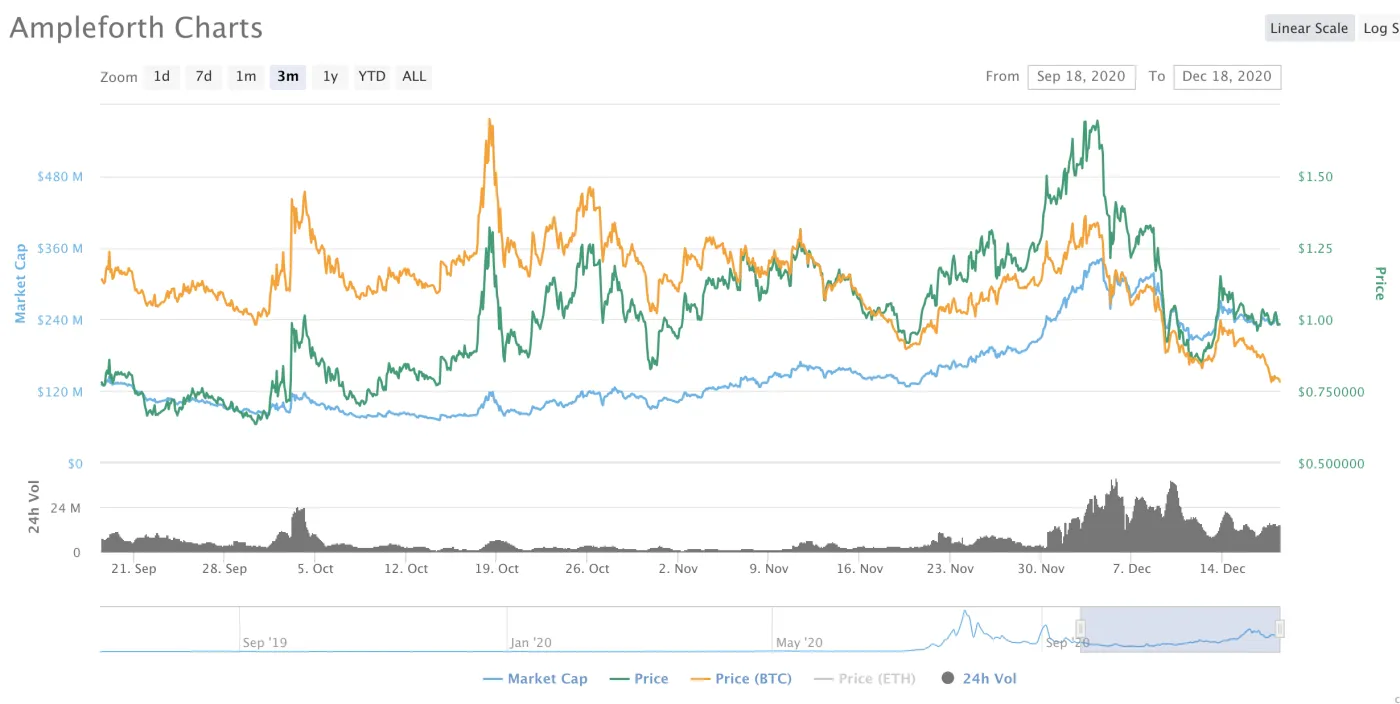
From an investor's point of view, rebase is really nothing more than a trap. The idea that an ordinary coin, which cannot hold a fixed value, maintains a target price doesn't actually make sense. As you know, the foundation of economics is supply and demand, and rebase amounts to artificially adjusting supply amid limited demand. As a result, the target price may somehow be maintained, but the problem is that it's useless if there isn't demand to back it up.
For example, say you hold 1,000 AMPL, and the price falls 50%, so you now hold 2,000 AMPL. The value of your AMPL seems the same as before, but the problem is that only the supply has doubled. If investors get nervous and start pulling AMPL out of liquidity mining pools, latecomers will end up stuck holding huge amounts of AMPL. On paper, you keep your original investment, but in reality you end up holding a pile of digital scraps you can't sell.
The same goes when the price rises. In the end, the number of AMPL you hold decreases, so there's really little reason to invest in rebase tokens.
My Personal Opinion
Rebase coins are undeniably an innovative model that maintains value by elastically adjusting circulating supply. In terms of value, rebase resembles stablecoins, and in terms of how it works, it resembles the liquidity mining model, but in reality it is completely different, so you need to be careful. Especially with tokens that have almost no liquidity, there's a high chance you'll suddenly end up holding a mountain of digital garbage through a rebase.
Of course, rebase coins aren't the only ones whose supply changes. Bitcoin also changes its supply gradually through halvings. The difference is that with a rebase, the number of coins you currently hold also changes, and unlike halvings, the amount of change can't be predicted. It may differ by project, but my conclusion is that rebase = a (smart-looking) trap.