What Is Aster (ASTER)? Everything About the Decentralized Futures Exchange (DEX)
6 min read · · Korean original
Contents 8
Aster (ASTER) has recently been drawing a lot of attention in the decentralized futures exchange (DEX) market. What is Aster, and why is it so popular? In this post, we'll look at the Aster platform's features and what sets it apart, as well as how to earn points for upcoming airdrops.
What is Aster?
Aster (ASTER) is a decentralized exchange (DEX) specialized in perpetual futures trading. It has completed its rebrand from Apollox, and structurally it aims for performance similar to Hyperliquid.
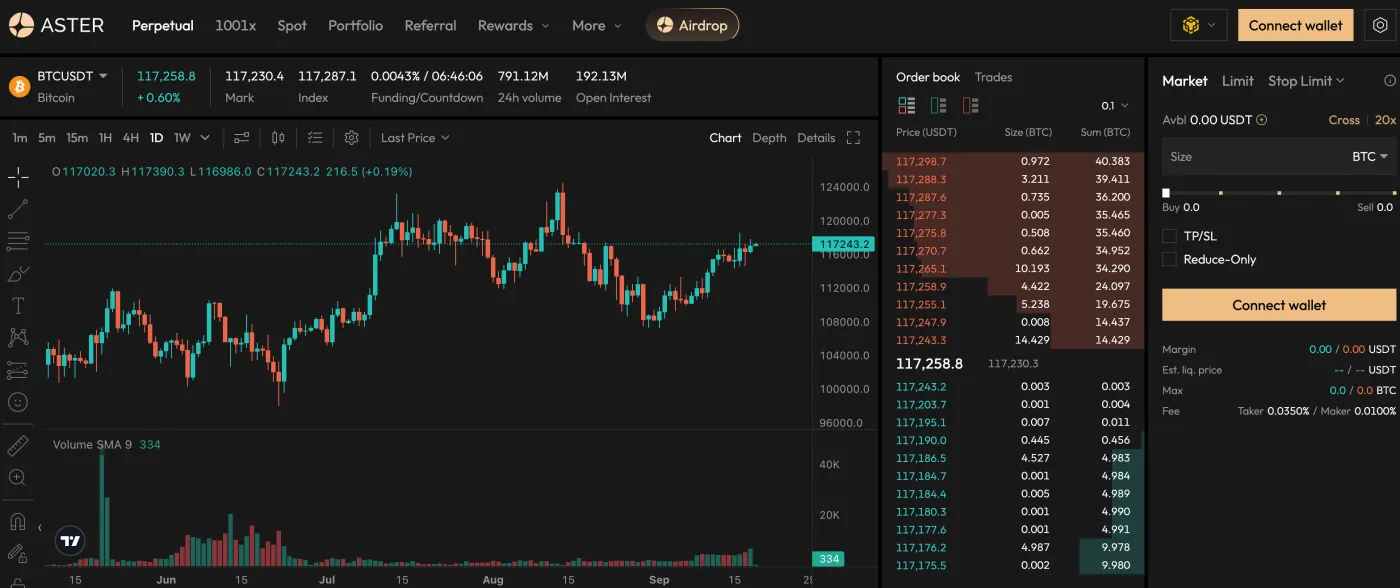
Since the launch of its own token, $ASTER, Aster's trading volume and user base have surged, and interest in earning points for upcoming airdrop seasons is also growing.
What are Aster's features?
Aster is growing quickly in the decentralized derivatives market thanks to the following features.
(1) You hold your own assets
The biggest feature of the Aster platform is that you don't deposit your assets with the exchange; instead, you trade directly from your personal wallet. In other words, you manage your assets yourself through a self-custody wallet such as MetaMask or OKX Wallet.
(2) Trading based on an on-chain order book
Rather than the automated market maker (AMM) model commonly used in DeFi, Aster adopts an order book model, which allows limit and market orders at more accurate prices.
(3) Focused on perpetual futures
Aster is a platform specialized in perpetual futures. Users can enjoy a trading experience on par with established exchanges like Binance or Bybit. However, due to the nature of an on-chain decentralized platform, speed and liquidity may fall short compared to centralized exchanges.
(4) Point-based reward system
On the Aster platform, you can earn points by trading, holding positions, depositing BNB, and more. Aster has successfully completed its Season 1 airdrop, and airdrops for new seasons are now underway.
Why is Aster getting so much attention?
Aster addresses the limitations of the former Apollox platform, with a complete overhaul of its user interface, reward structure, and technical stability. It also successfully completed the launch of the $APX token through Binance Alpha.
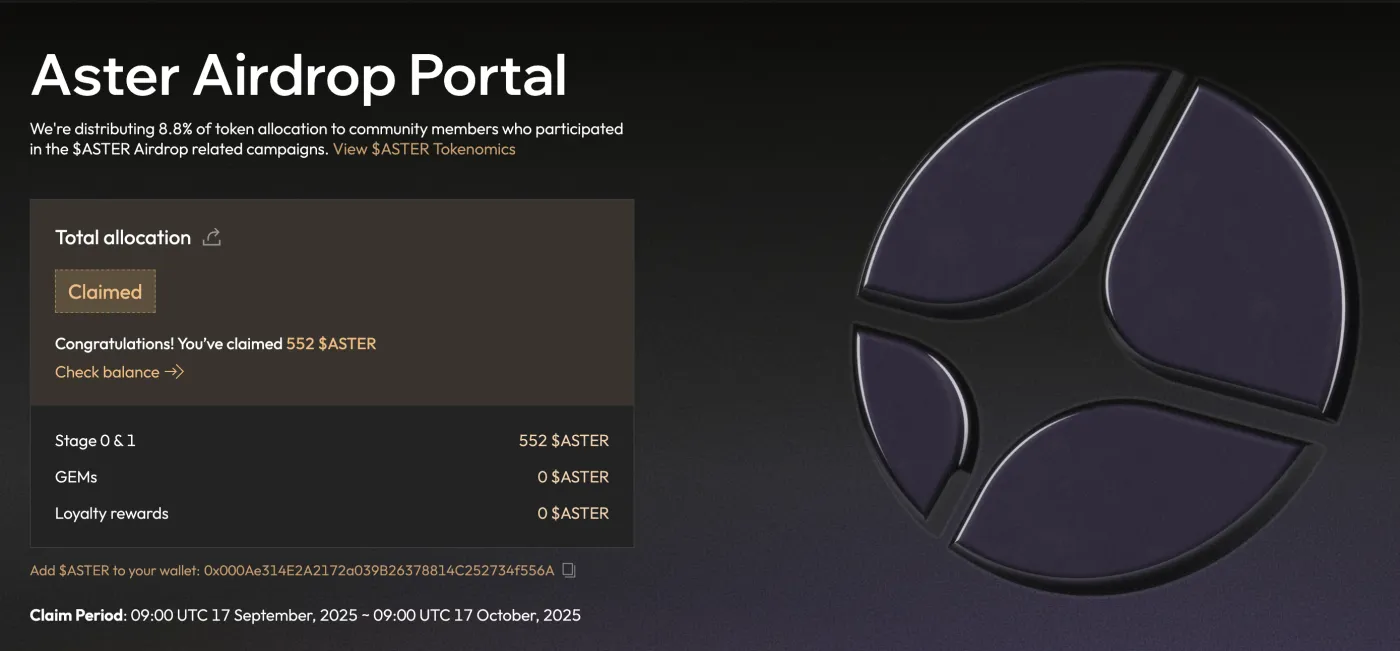
Recently, along with the launch of the $ASTER token, it also offered a 1:1 swap for $APX tokens. Since its launch, $ASTER's trading volume has increased by more than 900%, and the token price has also quickly risen more than threefold.
In addition, Aster is structurally very similar to Hyperliquid, offering an on-chain order book and matching system. For this reason, some users are watching Aster closely, expecting it to grow into the next Hyperliquid.
How do you get an airdrop on Aster?
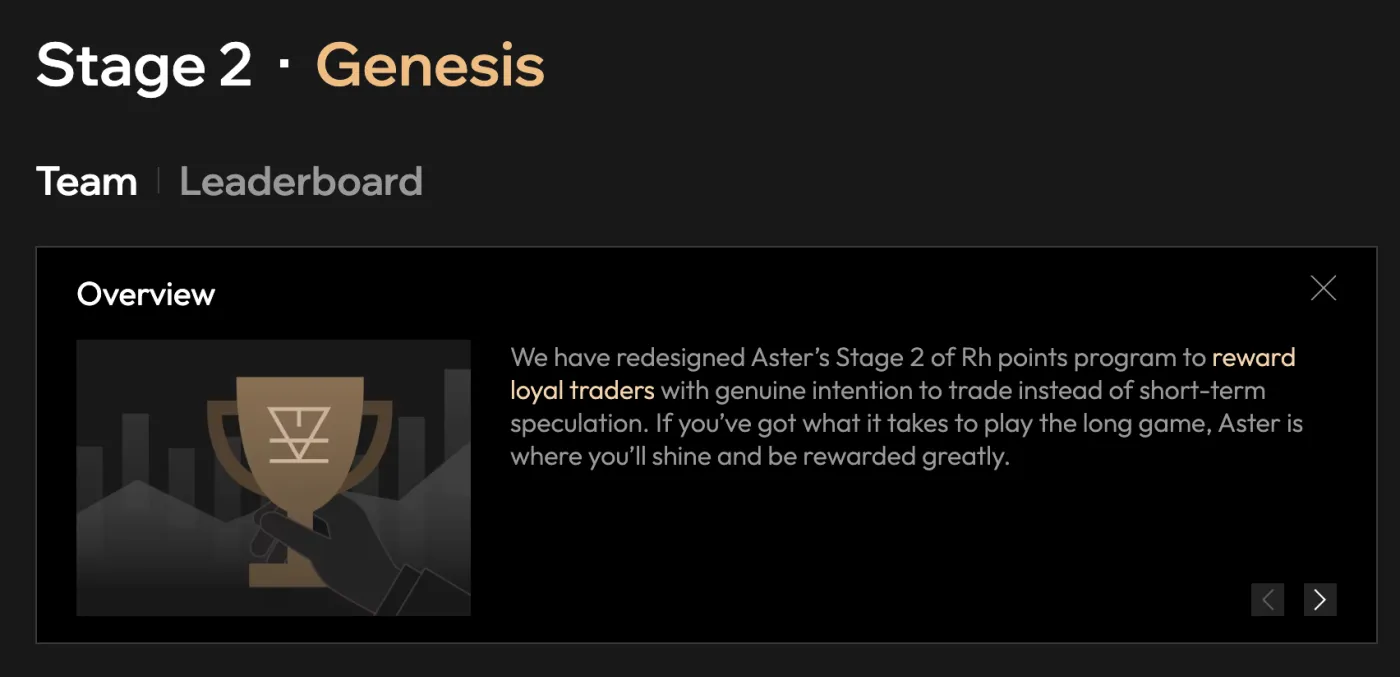
Aster is currently running a point system, which is expected to lead to a future Aster coin (ASTER) airdrop. To receive the Aster airdrop, visit Aster through the link below and connect your wallet.
Once you've connected your wallet to Aster, you can earn Aster points through various trading and on-chain activities. The main ways to earn points are as follows.
| Futures trading | Open positions on trading pairs such as BTC/USDT |
| Holding positions | Earn points by keeping positions open for a certain period of time |
| Depositing assets | Raise your score by depositing assets used for trading (BNB, etc.) |
| Connecting a wallet | Connect your wallet to the Aster platform and build an activity record |
What is the Aster coin?
$ASTER is the native token of the Aster (ASTER) platform, a utility asset that serves a variety of functions. The Aster coin was converted and distributed at a 1:1 ratio to existing Apollox coin holders, and it continues to be distributed further through trading activity, point accrual, participation rewards, and more on the platform.
The main uses of the Aster coin can be broadly divided into the following three.
- You can receive trading fee discounts on the Aster platform.
- You'll be granted governance rights to participate in the DAO (decentralized autonomous organization) that the platform will run in the future.
- It is expected to be used as a means of paying rewards for certain activities.
Currently, $ASTER can be traded on decentralized exchanges and wallets based on BNB Smart Chain (BSC). The Aster coin's tokenomics are still at a relatively early stage, but as the platform grows, its role as a core asset that handles both rewards and governance is expected to expand.
How does it differ from Hyperliquid?
Technically, Aster is built on a structure similar to Hyperliquid, but it stands apart by having a lower barrier to entry and a reward structure that favors early users.
First, they differ in their underlying chain. Hyperliquid uses its own in-house Layer 1 blockchain to achieve ultra-fast trade execution and low fees, whereas Aster is based on BNB Smart Chain (BSC), offering easier accessibility and compatibility.
In terms of trading structure, both platforms adopt an on-chain order book. In other words, rather than an automated market maker (AMM) system, they share a structure in which users enter orders directly at the price and quantity they want, and those orders are matched.
However, there is a difference in execution speed. Thanks to its own chain, Hyperliquid offers an ultra-low latency environment, while Aster has some speed constraints due to the limitations of BSC, but it still provides a trading environment that is fast enough for ordinary users.
The reward structure is another important difference. Aster puts its points accrual → token conversion or rewards structure front and center, designing it so that real benefits go to early users. Hyperliquid, on the other hand, has a reward design centered on advanced trading features, building a system better suited to professional traders.
When it comes to getting started, Aster has the simpler setup. You can start using it right away just by connecting a BSC wallet such as MetaMask, and no KYC is required. Hyperliquid offers a relatively advanced user interface geared toward professional traders, so beginners may find it somewhat harder to get into.
Finally, looking at DAO participation, Hyperliquid already operates an active community governance system, while Aster is still at the pre-launch stage, but it is preparing to introduce a community-driven decision-making structure centered on the ASTER token in the future.
To sum up, if Hyperliquid is a platform with high performance and professional-grade features, Aster is a structure that emphasizes accessibility for more users and early reward opportunities, so you could say the two have adopted differentiated strategies aimed at different user groups.
Frequently Asked Questions (FAQ)
- Q1. How do I sign up for Aster?
- Just connect a BNB Smart Chain (BSC) wallet and visit the official page.
- Q2. Is the airdrop confirmed?
- Yes. In line with the existing point system, $ASTER rewards are planned for the future.
- Q3. Where can I buy the ASTER token?
- It can currently be purchased on BSC-based DEXs, and it is expected to be supported on centralized exchanges such as Binance and Bybit in the future.
- Q4. What makes it special compared to other DEXs?
- Its main differentiators are an order book-based structure rather than an AMM, and a reward system that favors early participants.
- Q5. Where can I check my points?
- Once you connect your wallet and log in, you can check your points in real time on the platform's dashboard.
Wrapping Up
Aster (ASTER) is an on-chain perpetual futures DEX with a structure similar to Hyperliquid, and it has been growing rapidly since its recent rebrand.
Whether Aster can become the next Hyperliquid remains to be seen, but it is attracting a lot of users' interest thanks to expectations of a points-based airdrop, its easy wallet connection, and its self-custody, rewards-focused structure.