What Is ERC-404, the Token Standard Everyone Is Talking About
4 min read · · Korean original
Contents 5
What is ERC-404, the Ethereum token standard that has been drawing so much attention lately? As a new token standard, ERC-404 plays an important role in making the existing world of NFTs (non-fungible tokens) more diverse and liquid.
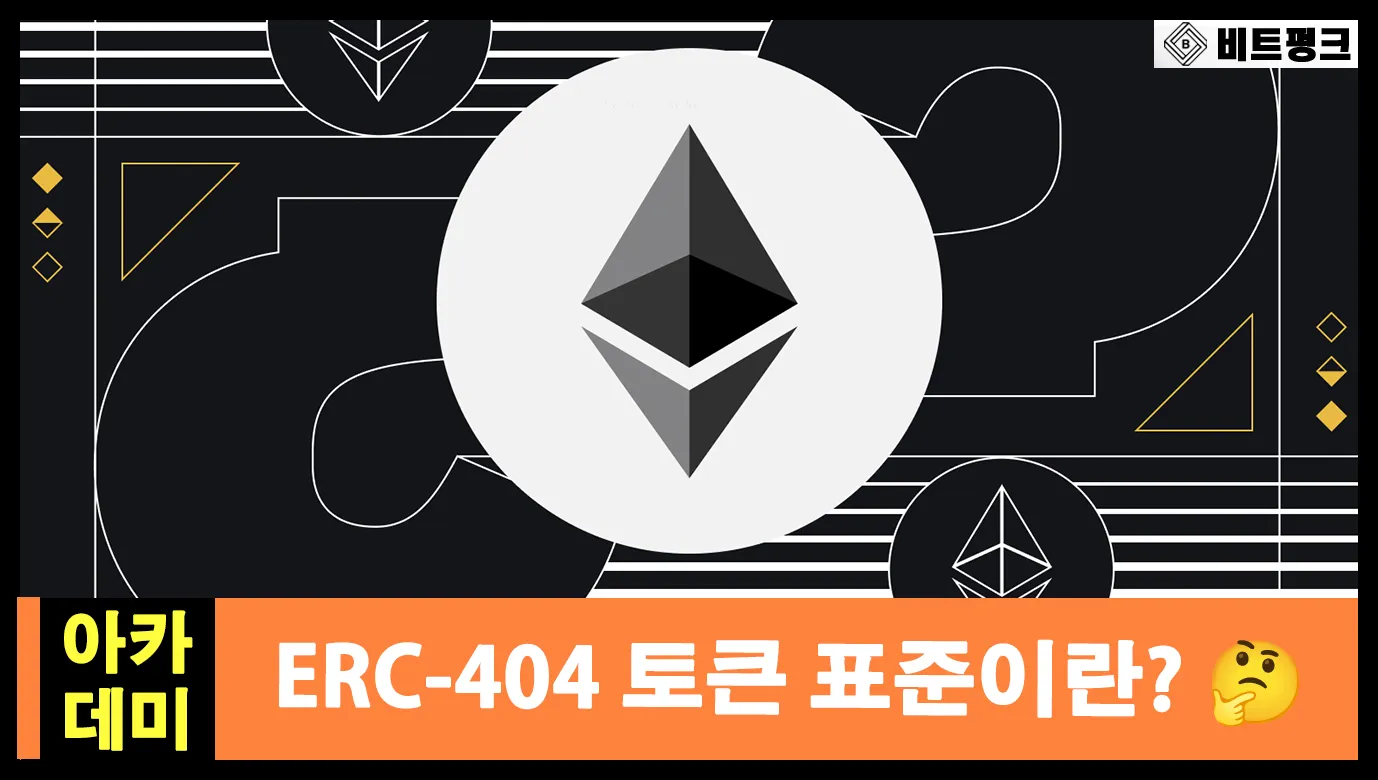
In this post, we'll take a close look at ERC-404, from its concept and how it works to its features and future outlook.
Ethereum has something called token standards. A token standard is a kind of protocol (set of rules) that must be followed when issuing a smart contract. This allows each smart contract to execute automatically, without an intermediary, once its conditions are met.
The best-known Ethereum token standards are ERC-20, for managing tokens on the blockchain, and ERC-721, for NFTs. ERC-404 is a new token standard that borrows features from the existing ERC-20 and ERC-721.
What Is ERC-404?
ERC-404 is a new token standard for digital assets on the Ethereum blockchain. It is a token standard that combines existing fungible tokens (ERC-20) and non-fungible tokens (ERC-721) into a single "semi-fungible" digital asset.
With ERC-404, NFTs can be divided, and portions of an NFT can be transferred and traded. This adds liquidity to the NFT market. So how exactly does ERC-404 work?
How ERC-404 Works
NFTs (Non-Fungible Tokens) are digital assets that cannot be divided, because each one is unique. In other words, you can own one whole NFT, but you can't split it up and own just a part of it. ERC-404, however, introduces a token minting and burning mechanism to overcome this limitation, making it possible to trade and transfer portions of an NFT.
The ERC-404 protocol works by linking the issued tokens to NFTs: when you buy a whole token, an NFT is minted to the connected wallet. Conversely, when you sell part of a token, the corresponding NFT is burned. In this way, ERC-404 lets you split NFT ownership and trade it in a variety of ways.
What Makes ERC-404 Special
By making NFTs divisible, the ERC-404 token standard allows portions of NFTs to be traded. As a result, additional liquidity is created in the NFT market.
The Pandora team adopted ERC-404 and traded NFTs as tokenized assets on a real market. According to the Pandora team, NFTs implemented with ERC-404 can "create a token ecosystem that reflects the floor price in real time."
ERC-404 token holders can buy and sell NFTs from liquidity pools. This means you don't need a counterparty to buy an NFT. In addition, there's no need to lock up or wrap an NFT and then issue tokens for it; the NFT itself can be divided and traded.
Notable ERC-404 Projects
So what are some notable ERC-404 projects? The three best-known projects so far are Pandora, DeFrogs and Monkees.
- Pandora: Pandora is the first project to adopt the ERC-404 token standard. It consists of 10,000 Pandora ERC-20 tokens and 10,000 linked "Replicant" NFTs. When you buy Pandora tokens on an exchange, a Replicant NFT is minted to your wallet.
- DeFrogs: DeFrogs is a collection of 10,000 Pepe the Frog–themed NFTs that uses a variant of the ERC-404 token standard. Its creators claim it is the first ERC-404 PFP collection and that it prevents deflation.
- Monkees: Another PFP collection using the ERC-404 token standard, Monkees consists of 100 NFTs with 10 attributes and 6 traits.
The Future and Outlook of ERC-404
ERC-404 is an experimental Ethereum token standard with real potential, but it is still experimental and unofficial. This means that, unlike ERC-20 and ERC-721, it has not been reviewed as an Ethereum Improvement Proposal (EIP) or undergone an external audit. As a result, there may be undiscovered issues that could pose significant risks to token holders.
The development team has worked to implement ERC-404 as safely as possible, but acknowledges that it is still a "non-standard" implementation of ERC-721. The team behind the token standard plans to submit ERC-404 as an official Ethereum Improvement Proposal, but review and approval could take a long time.
To sum up, ERC-404 can be described as an innovative token standard that brings liquidity to NFTs and lets them be divided, owned and traded in portions. However, since it is an unofficial standard, it still needs further review and auditing, and anyone using it should carefully consider the risks involved.