What Is Ethereum 2.0 Serenity? A Simple Explanation, Including How It Differs from the Current Ethereum
3 min read · · Korean original
Contents 3
Hello, this is Bitpunk. Today, we'll look at what Ethereum 2.0 is and what changes compared to the current Ethereum.

Ethereum vs. Ether (ETH)
Before we look at Ethereum 2.0, we need to understand the difference between Ethereum and Ether (ETH). People often use the terms Ether (ETH), the coin traded on crypto exchanges, and Ethereum interchangeably, but the coin that is traded is Ether (ETH), and the platform that uses it is called Ethereum. In other words, Ether is the coin we trade, and Ethereum is the platform on which various dApps and other services are built.
What Is Ethereum 2.0, and How Is It Different from the Current Ethereum?
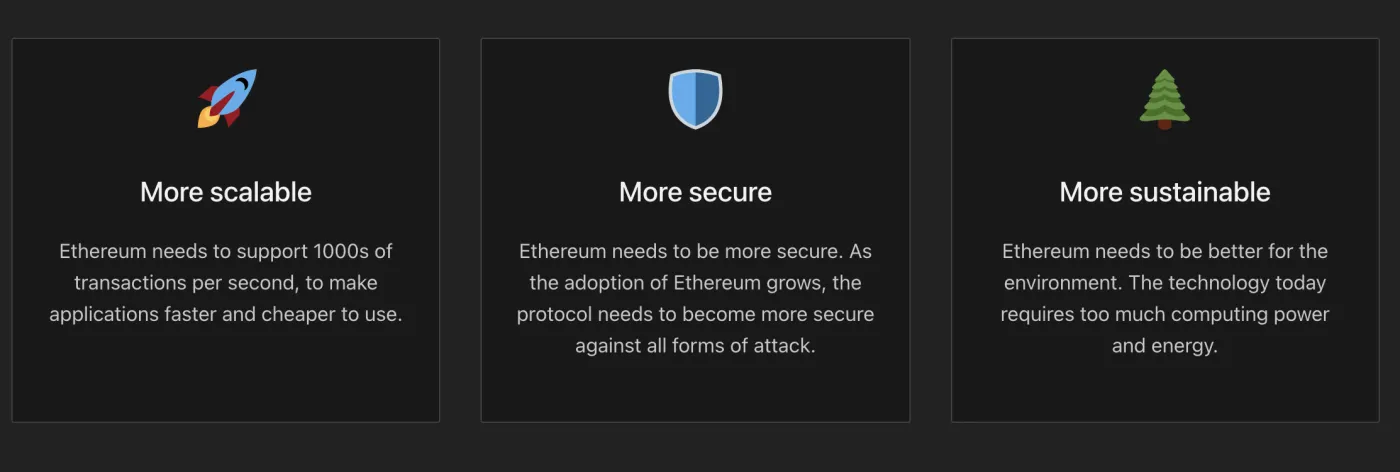
Ethereum 2.0 is an upgrade to this Ethereum network. Not only during the recent DeFi boom, but also back in Ethereum's early days with the game CryptoKitties, Ethereum showed serious scalability problems. The Ethereum network adjusts gas fees dynamically according to congestion, so when many users rush in at once, you may have to pay tens of thousands of KRW, or in extreme cases hundreds of thousands of KRW, worth of gas in Ether for a single transaction. Ethereum 2.0 is being launched specifically to deal with these scalability problems.
1. The Switch to Proof of Stake
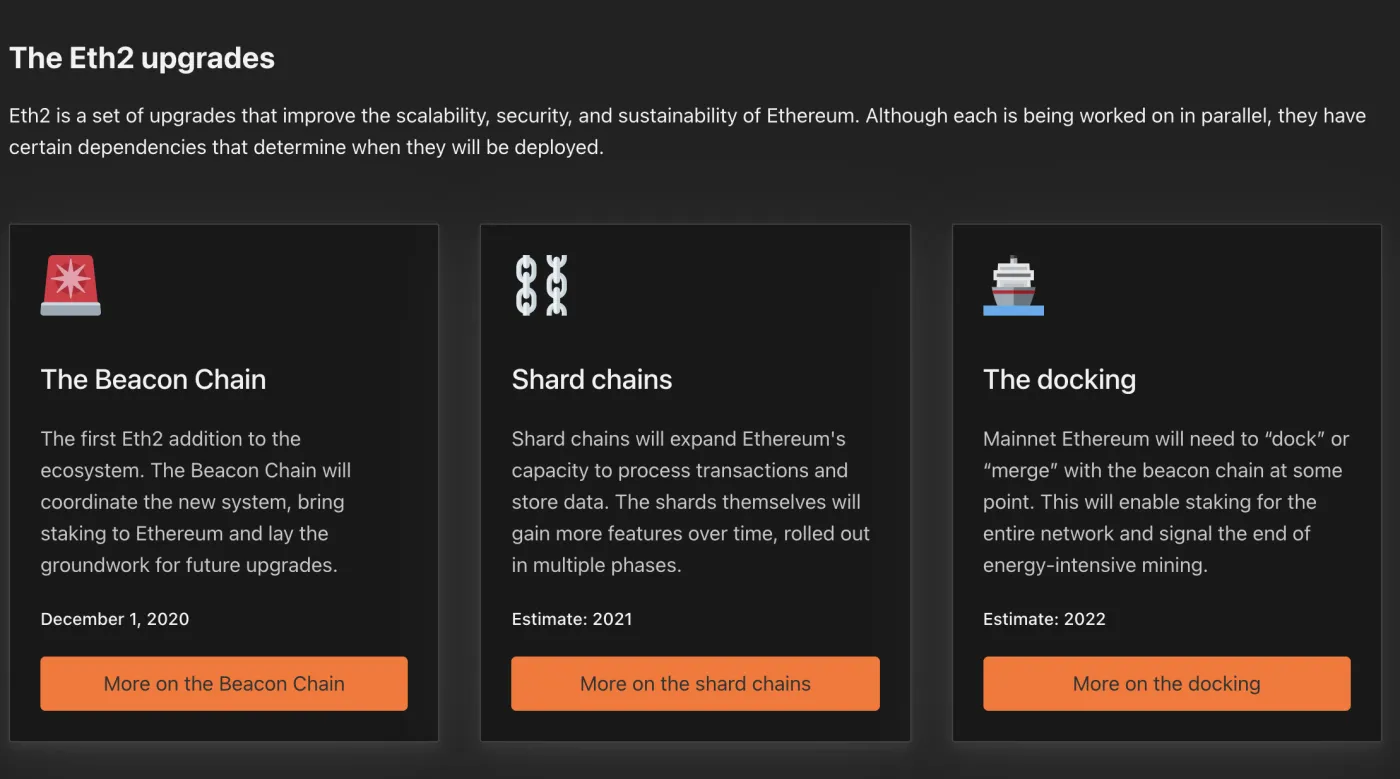
The first feature is the switch from the existing Proof of Work to Proof of Stake. Proof of Work is used by many crypto networks, including Bitcoin. It offers excellent network security, but it has the drawback of making scalability hard to handle. It also leads to a competitive waste of an excessive amount of computing resources. Ethereum currently follows the Proof of Work consensus algorithm as well, but Ethereum 2.0 switches to Proof of Stake. To become a validator on the newly launched Ethereum 2.0, you need to deposit at least 32 Ether.
2. Introducing Shard Chains
Nodes on a blockchain basically have to hold a copy of every transaction. In other words, they have to keep the complete record, from the very start of the network up to the most recent block. The problem is that as a blockchain network grows, nodes have to hold more and more transactions, and as a result the overall network slows down. A shard means a "piece" or "part," and sharding lets each node store only a portion of the Ethereum network's transactions. In other words, each node becomes lighter than before, and overall throughput increases. Then how can the integrity of the blockchain network be guaranteed?
3. The Beacon Chain
The beacon chain is what comes in to keep the blockchain of each shard chain intact. The beacon chain keeps the shards, which run in parallel, in sync and allows them to form a complete blockchain. It can be called the core of Ethereum 2.0, and it is also the first stage of the roadmap.
Ethereum 2.0 in Summary
To sum up Ethereum 2.0 very simply: it "gets faster". You might ask what's so hard about speeding up a network, but achieving this in a decentralized way while maintaining security is no easy problem. This is also known as the blockchain trilemma.
According to the roadmap, Ethereum 2.0 will be rolled out in stages through 2021, and if the launch succeeds, it looks like transactions will be processed quickly with lower gas fees than today.
That wraps up our look at Ethereum 2.0.