What Is Ethereum and How Does It Work
10 min read · · Korean original
Contents 8
TL;DR
- Ethereum is the blockchain network with the second-largest market capitalization after Bitcoin, and it uses Ether (ETH) as its native currency.
- In 2022, the Ethereum network switched its consensus mechanism from proof of work to proof of stake to improve the network's functionality.
- Ethereum's founder, Vitalik Buterin, focused on utility, providing infrastructure on which a wide range of decentralized applications can be built.
- The Ethereum ecosystem spans DeFi, gaming, NFTs, DAOs and more, and has established itself as a foundational layer of the digital economy.
What is Ethereum?
Ethereum was created in 2014 by programmer Vitalik Buterin. Ethereum is a decentralized, open-source platform that runs around its native currency, Ether (ETH). Unlike traditional systems that run on centralized servers, Ethereum runs on a vast network of interconnected computers called nodes. Because these nodes are distributed around the world, the platform stays resilient against single points of failure and censorship.
Ethereum and Bitcoin, the first blockchain protocol, both serve as platforms for digital money transfers, but the difference is that Ethereum is used much more broadly. Ethereum acts as a platform for deploying 'smart contracts', autonomous computer program code that automatically carries out tasks when certain conditions are met. This reduces the need for intermediaries and provides better transaction transparency.
Thanks to these capabilities, Ethereum has become an essential platform tool for developers building decentralized applications (DApps). Examples of DApps range from DeFi platforms to games, and each DApp can take advantage of Ethereum's robust infrastructure.
How is Ethereum different from Bitcoin?
Ethereum uses blockchain technology just like Bitcoin, but the two have different purposes and philosophies. Here are the main differences between Ethereum and Bitcoin.
- Purpose of launch
Bitcoin, launched by Satoshi Nakamoto in 2009, was designed as an alternative to traditional currencies. Bitcoin was conceived as a decentralized form of money that isn't affected by government interference or inflation. Bitcoin's main functions are to serve as a medium of exchange, a store of value, and a unit of account.
Vitalik Buterin, on the other hand, created Ethereum in 2014 with a bigger vision. Ethereum uses its own cryptocurrency, Ether (ETH), but Ethereum's true purpose goes beyond simple transactions. Ethereum was designed as a platform where developers can build and deploy smart contracts and decentralized applications (DApps). This makes it possible to build programmable transactions as well as complex and diverse applications such as DeFi. - Smart contracts and DApps
The smart contracts and DApps mentioned above are what make Ethereum especially distinctive. Bitcoin also offers smart contract functionality, but Ethereum's is more general-purpose and flexible, allowing a wide range of applications, from games to DeFi platforms, to be built on top of the Ethereum platform. - Tokenomics
Bitcoin has a limited supply, and only up to 21 million coins can ever be mined. This scarcity is one of Bitcoin's core values. Ethereum, by contrast, has no supply cap, so it can be issued without limit. However, since switching to proof of stake (PoS) in 2022, Ethereum has shown deflationary characteristics.
In short, Bitcoin and Ethereum both use blockchain technology, but they were launched for different purposes. Bitcoin aims to revolutionize the way we perceive and use money, while Ethereum seeks to revolutionize the way applications and contracts operate in a decentralized environment.
How does Ethereum work?
As we saw above, Ethereum is meant for more than simply transferring assets, so its operating mechanism has several unique design features.
- Smart contracts
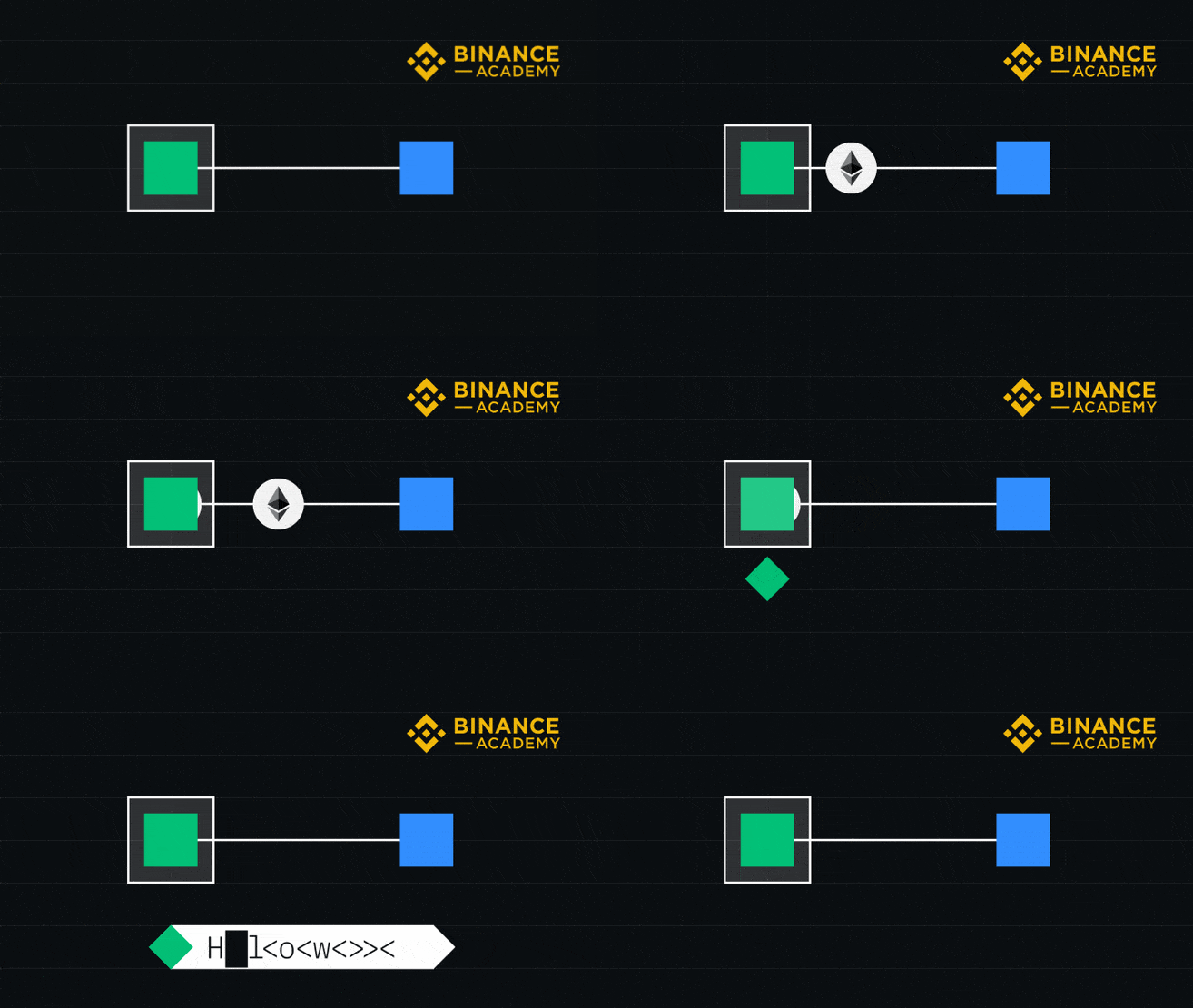
A smart contract is a self-executing contract whose terms are written in code. Once a smart contract is deployed on the Ethereum blockchain, it autonomously carries out predefined functions when certain conditions are met. For example, a smart contract can automatically transfer funds from one party to another on a specified date. - DApps
DApps built on the Ethereum platform are applications that run on the blockchain. They use Ethereum's smart contract functionality to ensure that all data and transactions are secure, transparent and immutable. This has given rise to a wide variety of decentralized platforms, ranging from DeFi and GameFi to decentralized identity. - Ether and gas
At the heart of Ethereum is its native currency, Ether (ETH). Ether can be used for P2P transactions like Bitcoin, but it is mainly used within Ethereum to drive the ecosystem and provide incentives. Every operation on Ethereum, from a simple transfer to a complex smart contract interaction, requires Ether. The cost of these operations is expressed in "gas," and users pay gas fees using Ether. - Ethereum Virtual Machine (EVM)
The Ethereum Virtual Machine serves as the runtime environment for smart contracts on Ethereum. It isn't confined to the Ethereum network alone; it is mirrored across every node in the Ethereum ecosystem, promoting decentralized, consensus-driven operation. This establishes a high level of security and uniformity across the network. - The EVM's design also plays a pivotal role in promoting interoperability. Various blockchain platforms have recognized the EVM's potential and are integrating EVM-compatible layers or mechanisms into their systems. As a result, smart contracts designed for Ethereum can be deployed and run on EVM-compatible blockchains without major modifications. This adaptability not only reduces development effort but also connects different blockchain communities, expanding the ecosystem of decentralized applications.
- Consensus mechanism
Ethereum originally ran on a proof of work (PoW) consensus mechanism, just like Bitcoin. However, in 2022 the network successfully switched to proof of stake (PoS) through the Ethereum 2.0 upgrade. Proof of stake has improved Ethereum's scalability and energy efficiency. Under proof of stake, validators create blocks and earn rewards based on the assets they have 'staked,' or deposited as collateral.
In essence, Ethereum not only enables digital asset transactions but also serves as a platform that gives trustless applications and contracts the opportunity to grow in a decentralized way.
Ethereum's transition from proof of work to proof of stake
Ethereum originally relied on a process known as mining, using a proof of work (PoW) consensus algorithm similar to Bitcoin's. But on September 15, 2022, through a landmark event called 'The Merge,' it switched to a proof of stake (PoS) model for updating the network's state. The transition to proof of stake completely ended Ethereum's proof of work and dramatically cut its energy consumption by nearly 99.95%.
Proof of stake is a consensus algorithm introduced in 2011 as an alternative to proof of work. Proof of stake aims to overcome the scalability limits of proof of work networks. It is the second most widely used consensus algorithm and has been adopted by chains such as BNB Chain, Solana (SOL), and Cardano (ADA).
What is Ethereum 2.0?
Ethereum 2.0 (also known as Eth2 or "Serenity") is a long-awaited upgrade to the Ethereum network that improves the network's scalability. Ethereum 2.0 was eventually launched, but it took several years to arrive. That's because scaling a blockchain in a secure and decentralized way was a difficult task.
To ensure a successful launch, Ethereum 2.0 was rolled out gradually in three main phases: Phase 0, Phase 1/1.5, and Phase 2. Each phase integrated new, effective and essential features into Ethereum.
Phase 0 successfully introduced the Beacon Chain, launched on December 1, 2020. The Beacon Chain ran in parallel with the mainnet and focused on recruiting validators (or stakers) through a one-way deposit contract. Validators' ETH remained locked until the next phase, so unstaking only became possible after shard chains were fully implemented.
Phase 1/1.5 combined two steps: the introduction of shard chains and the transition of the Ethereum mainnet from proof of work (PoW) to proof of stake (PoS). Phase 1 introduced shard chains, on which validators can create blocks on the blockchain through proof of stake. Phase 1.5 began rolling out in 2021 and was the phase in which Ethereum officially moved away from proof of work.
In the final stage, Phase 2, Ethereum 2.0 fully supports shards and serves as the official Ethereum network. Shard chains work together with smart contracts, allowing Ethereum 2.0 to integrate smoothly with DApps and various technologies.
The Ethereum ecosystem: decentralized finance, NFTs and DAOs
Since Ethereum launched, countless applications have been developed on the platform. Ether has now become the second-largest crypto asset in the world. Here are some of the exciting applications in the Ethereum ecosystem.
- DeFi
DeFi refers to financial applications built on blockchain infrastructure. DeFi's distinctive feature is that it operates without a central authority and offers an open, programmable financial system. - Users can securely deploy decentralized financial applications by using smart contracts and distributed systems. Today, DeFi businesses offer a variety of services, including P2P lending and borrowing, interest payments, and decentralized exchanges. Compound Finance, Aave, and Uniswap are some of the notable decentralized finance platforms.
- Gaming
Gaming and virtual reality make up a large part of the Ethereum network. Decentraland and The Sandbox are the largest platforms that have built virtual worlds. The Ethereum blockchain is used to secure tokenized ownership of land, avatars, wearables and other goods. - Non-fungible tokens (NFTs)
Non-fungible tokens (NFTs) are tokenized versions of digital or real-world assets that function as verifiable proof of authenticity and ownership within a blockchain network. They let you create and own unique digital items and collectibles in decentralized applications (DApps). NFTs have the potential to become one of the key building blocks of the new blockchain-based digital economy.
NFTs can be used in many fields, including video games, digital identity, licenses, certificates and artwork, and can even be used to sell fractional ownership of goods. Storing ownership and identification data on the blockchain strengthens data integrity and privacy, and makes it easy to transfer and manage these assets in a trustless way. - Various frameworks have been created to make issuing NFT tokens easier. The most notable of these is ERC-721, a standard for issuing and trading non-fungible assets on the Ethereum blockchain. This standardization of NFTs has enabled a higher level of interoperability, making it relatively easy to transfer unique NFT assets between applications.
- DAO development
A decentralized autonomous organization (DAO) is a community-led organization that is governed by computer code and has no central authority. These organizations use smart contracts or applications to share information and hold votes transparently, without the help of third parties.
Frequently asked questions about Ethereum
- How is Ethereum different from Ether?
Ethereum is a blockchain platform that uses Ether (ETH) as its native currency. The Ethereum platform supports a variety of DApps built on the Ethereum blockchain. Ethereum itself can't be traded; the correct name for the coin actually traded on exchanges is Ether. - How do I buy Ethereum?
To buy Ether (or Ethereum), you can use an exchange such as Binance. If you sign up for Binance through this link, you can get a 20% discount. You can create an account on a trusted exchange and buy or swap Ether. - Is Ethereum a good investment?
As with any investment, whether Ethereum is right for you depends on your risk tolerance, financial stability, investment goals and so on. Ethereum is definitely a volatile investment asset, so you should do your own research to decide whether it's a suitable investment for you. - How does Ethereum generate revenue?
As a decentralized platform, Ethereum doesn't generate revenue the way traditional organizations do. People who take part in securing and maintaining the network as stakers and validators receive rewards. They earn Ether as a reward for validating transactions and creating new blocks. - Can I convert Ethereum to cash?
Yes! You can use a crypto exchange for this. Once you create an exchange account, you can link your bank account and sell your Ethereum. You can then withdraw the cash to your linked bank account. - What happens if I lose my Ether?
If you lose your Ether through your own mistake or a hack, you can't get it back. You can store your coins on an exchange or in a personal wallet, but please keep in mind that if you use a personal wallet, you must take care of your seed phrase.
That wraps up our detailed look at what Ethereum is, how it differs from Bitcoin, and how it works. I hope this post was helpful. Thank you.