What Is the Ethereum Pectra Upgrade and Why Should You Pay Attention to It
4 min read · · Korean original
Contents 5
Hello, this is Bitpunk. In this post, we'll talk about Ethereum's Pectra upgrade. With the upgrade successfully rolled out, Ethereum has become "faster and cheaper."
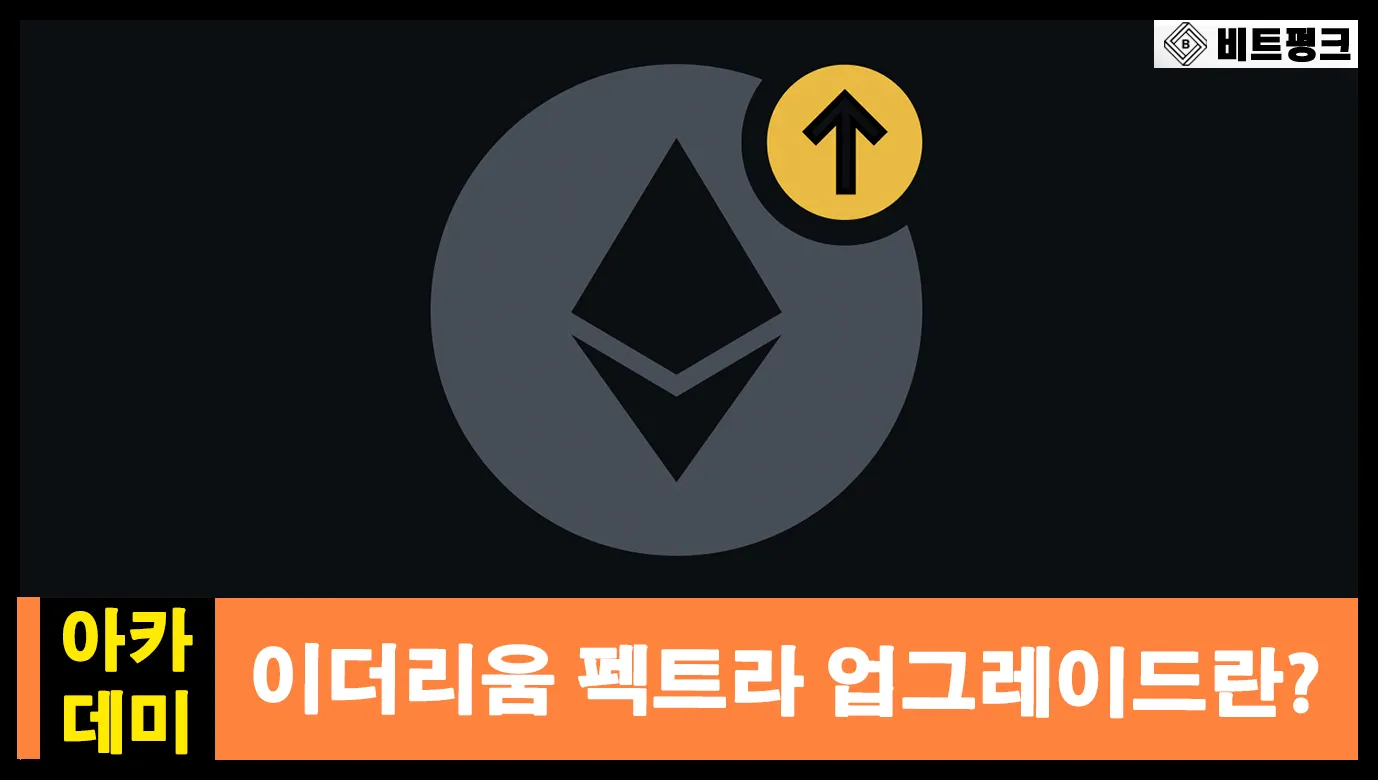
Sounds too vague? It isn't. The Pectra upgrade is essential to Ethereum's long-term growth, and it can be summed up in the following 3 features.
- You don't have to pay gas fees in ETH anymore! After the Pectra upgrade, gas fees can also be paid with tokens like USDC and DAI.
- Better validator rewards and scalability: the maximum staking limit goes up, and validators can be consolidated.
- A technically faster and lighter Ethereum: "Verkle Trees" and "PeerDAS" let the network process more data efficiently.
Ethereum Keeps Upgrading
In 2022, Ethereum switched to Proof of Stake (PoS) through "The Merge," and it improved its scalability problems with the "Cancun upgrade (2024)." Even so, some concerns still remained.
- Gas fees are expensive,
- the blockchain is slow,
- the staking limit is too low,
- and it's hard for beginners to get started.
That's where the "Pectra upgrade" comes in. The name may sound unfamiliar, but it's actually a combination of two upgrades: Prague + Electra.
Since both upgrades contained key changes for Ethereum's future, they were merged and carried out together, and that became the Pectra upgrade.
What Changes with the Pectra Upgrade?
1. Pay Gas Fees Without ETH: Account Abstraction
Until now, if you wanted to do anything on Ethereum, you had to hold at least a little ETH. Whether it was sending tokens, trading NFTs, or using dApps, you always had to pay "gas fees."
With Pectra, however, "Account Abstraction" is introduced. Account abstraction means "using your wallet like a smart contract," and it gives you the following benefits.
- Gas fees can be paid with other tokens like USDC and DAI
- A "gas sponsor" feature, where service providers pay gas fees on your behalf
In short, using dApps becomes much simpler, and even beginners who used to google how to top up for gas fees can join dApps more easily.
2. Faster Smart Contracts
With proposals like EIP-7692 being applied, smart contracts run faster and cost less. Developers can write less complex code, and users get to enjoy faster and cheaper services.
3. Maximum Staking Limit of 2,048 ETH
Currently, you need to stake 32 ETH to become a validator, and there were no rewards for anything above that. With this upgrade, however, you can stake up to 2,048 ETH (EIP-7251), and flexible withdrawals (EIP-7002) are also introduced.
In addition, a feature that consolidates validator nodes that were run separately into one is introduced, allowing large-scale validator services and restaking protocols to operate more efficiently.
4. Introducing "Verkle Trees": A Lighter Blockchain
The way data is stored and verified changes from "Merkle Trees" to "Verkle Trees." Here's how the two compare.
| Item | Merkle Tree | Verkle Tree |
|---|---|---|
| Storage space | Large | Small |
| Proof speed | Slow | Fast |
| Scalability | Limited | Excellent |
In short, with Verkle Trees introduced in the Pectra upgrade, the whole network becomes lighter and verification gets faster. For actual users, this means transaction speeds and fees could get better.
5. An Upgrade for Layer 2: PeerDAS
A technology called PeerDAS (Peer Data Availability Sampling) is also being introduced so that Layer 2 solutions like Arbitrum and Optimism can become more powerful.
What is it? It's a technology that makes the process of L2s storing and verifying data faster and lighter. As a result, Layer 2 fees go down and processing speeds go up. In other words, it's a key foundation for expanding the Layer ecosystem.
The Pectra Upgrade Rolls Out in Two Stages
At first, the Ethereum Foundation tried to release all the features at once, but with so many complex technologies involved, it judged that approach too risky. So the Pectra upgrade will be carried out sequentially in two stages.
| Stage | Timing | Key Features |
|---|---|---|
| Stage 1 | May 2025 | User-focused improvements such as account abstraction and validator upgrades |
| Stage 2 | Planned for 2026 | Technology-focused improvements such as PeerDAS and an EVM overhaul |
Who Benefits, and How?
(1) Regular Users
- Fewer gas fee worries ↓ (payments possible without ETH)
- Faster transactions
- Better access to services ↑ (even beginners can join easily)
(2) Validators and Stakers
- Rewards available on more ETH
- More flexible staking and withdrawals
- Greater efficiency by reducing the number of nodes
(3) Developers
- More efficient smart contracts
- Lower development costs
- Wider use of Layer 2
What Does the Pectra Upgrade Mean in the Long Run?
This isn't just a simple upgrade for Ethereum. You could say it's reshaping its fundamentals to become a platform that hundreds of millions of users can use in the future.
- A complete overhaul, from how data is stored to how payments are made
- Laying the groundwork for Layer 2 expansion
- An upgrade that considers developers, users, and validators alike
In the end, Ethereum, which once struggled after being pushed aside by Solana, has finally laid the foundation for becoming a faster, cheaper, and easier Ethereum.
Can Ethereum soar back to its previous all-time high? For more details, check out Binance Academy's 'Pectra Upgrade' article and Ethereum's 'official EIP website'.