Everything About Mantle (MNT) Coin (1) The Beginning of an Ethereum Layer 2 Solution
5 min read · · Korean original
Contents 4
Since mid-2023, a new Layer 2 solution has been a hot topic in the crypto community. And at the center of it were Mantle Network and Mantle coin (MNT).

Mantle Network is a Layer 2 solution that fully supports Ethereum Virtual Machine (EVM) functionality, and it has recently drawn attention once again as a utility token that offers a range of real-world benefits on the Bybit exchange.
So what is Mantle, and what features does it have? How did the Mantle project begin, and what does its future look like? Let's take a closer look at Mantle.
How did Mantle begin?
To understand today's Mantle coin, we first need to go back to a project called BitDAO, launched in 2021.
- BitDAO was a global Web3 project that started in 2021 as a decentralized autonomous organization (DAO).
- Its original purpose was to act as a funding DAO, investing in various Web3 projects and supporting the developer ecosystem.
- The token used at the time was $BIT, listed on Bybit, which was later rebranded as $MNT.
Unfortunately, BitDAO at the time was not sustainable on its existing token issuance model alone. Through a community vote, BitDAO decided to build its own Layer 2 blockchain, and as a result, Mantle Network officially launched in 2023.
- Through the BIP-21 and MIP-22 proposals, the BitDAO community voted to rebrand and convert the $BIT token to $MNT.
- This conversion was not just a name change; it was also the birth of a real Layer 2 network built on DAO funds.
In other words, today's $MNT is a coin that was launched in the process of turning $BIT, the coin of what was once a funding DAO, into a "technically functioning, real network."
What is Mantle coin used for?
Mantle coin ($MNT) is not simply a coin listed on the Bybit exchange. $MNT is a core utility token that plays a variety of roles within Mantle Network, including gas fees, governance, staking rewards, and collateral.
(1) Gas fees
$MNT is used to pay the gas fees incurred when executing transactions on Mantle Network. Just as $ETH is used on the Ethereum mainnet, $MNT is used on Mantle.
(2) Governance
Holding $MNT lets you take part in governance votes held by Mantle DAO. This structure gives Mantle holders direct influence over decisions such as network upgrades, fund allocation, and partnerships.
(3) Utility asset
$MNT can be used as a trading pair in various DApps, or as a staking asset for things like DeFi collateral and Launchpools. On the Bybit exchange, $MNT is also used for fee discounts and in calculating VIP tiers.
What are the features of Mantle Network?
Now let's take a closer look at the structure of Mantle Network, the "technical stage" on which $MNT operates. What is Mantle Network, and what features does it have?
(1) An Ethereum-based Layer 2 scaling solution
Mantle is a Layer 2 blockchain compatible with Ethereum. Basically, it's a structure that enables faster and cheaper transactions while keeping Ethereum's security intact.
- EVM compatibility: Because it's compatible with the Ethereum Virtual Machine, existing Ethereum DApps can be used as they are.
- Transactions aggregated, then recorded on Ethereum: Multiple transactions are bundled into one and stored on the main chain, reducing costs.
(2) Optimistic Rollups and zero-knowledge proofs
In its early days, Mantle used the Optimistic Rollup method. This was the same structure used by well-known scaling solutions like Arbitrum and Optimism. Today, however, Mantle is moving beyond this structure and adopting SP-1 (ZK Settlement Layer), which is based on ZK Rollups.
| Category | Optimistic Rollup | ZK Rollup |
|---|---|---|
| Processing speed | Fast | Faster |
| Data proof | Challenge-based (Fraud Proof) | Cryptographic proof (Validity Proof) |
| Security | Relatively high | Very high |
| Finality | Has a challenge period | Confirmed almost instantly |
In this way, Mantle Network has adopted a hybrid structure that combines both methods, and it is evolving into a structure well suited to high-performance DApps and financial products that require real-time settlement.
(3) Modular blockchain structure: a solution to the trilemma
Mantle's biggest technical differentiator is its Modular Architecture. While traditional blockchains handle every function within a single structure, Mantle splits up the functions and gives each one a processing structure optimized for it.
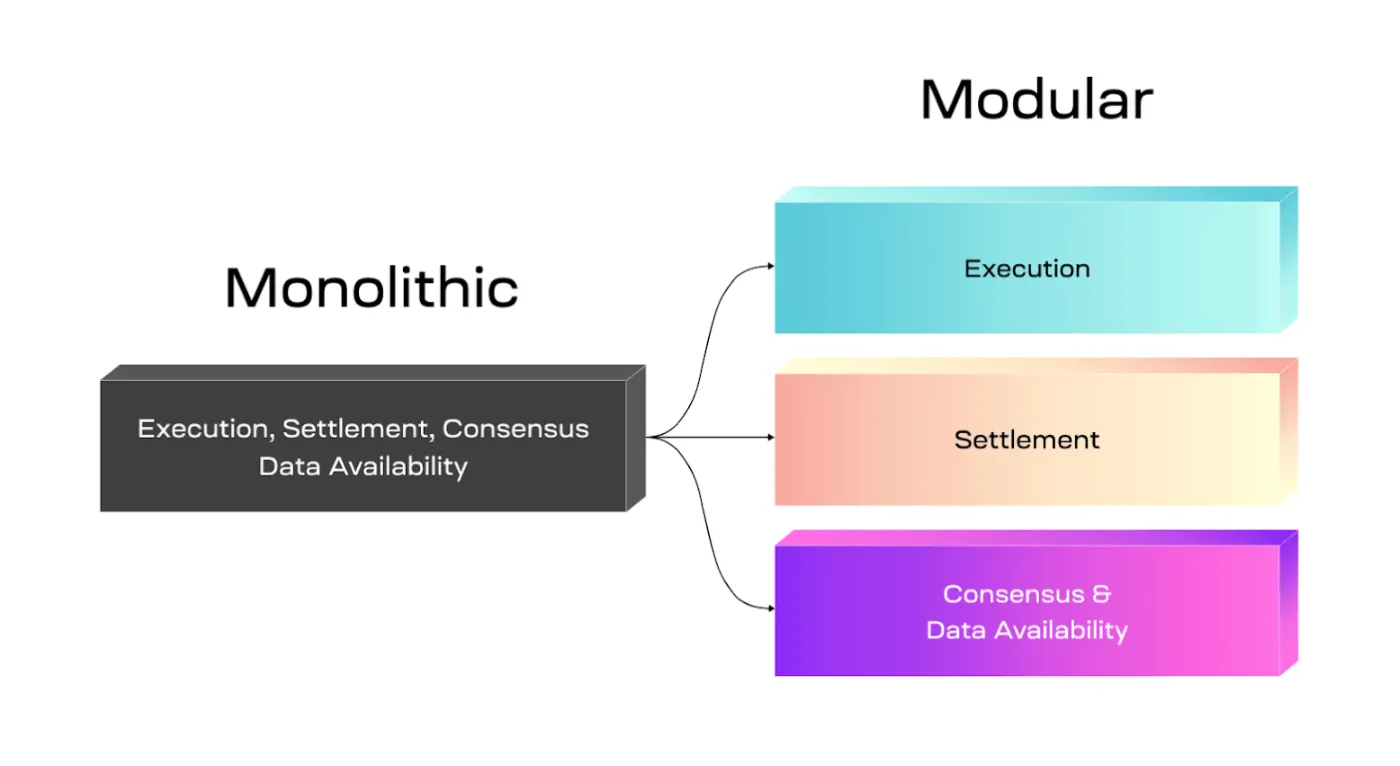
- Execution Layer: Executes smart contracts (EVM-based)
- Settlement Layer: Verifies and finalizes transactions (ZK/SP-1-based)
- Data Availability Layer: Stores data (uses EigenDA)
- Consensus Layer: Leverages Ethereum's security and consensus layer
Thanks to this structure, Mantle is attempting to overcome every part of the blockchain trilemma below, which has been difficult to overcome on blockchains like Ethereum.
| Element | Typical blockchain | Mantle Network |
|---|---|---|
| Scalability | Limited processing speed | Higher TPS through module separation |
| Decentralization | Costly node operation | Encourages staking by leveraging EigenLayer |
| Security | Standalone chains are vulnerable | Inherits security from Ethereum |
(4) Integration with EigenDA: solving the data problem
Data availability (DA) is one of the bottlenecks and weak points of Layer 2. To address this, Mantle has drawn attention as the first chain to integrate EigenDA.
EigenDA is a data storage solution built on top of EigenLayer. It operates on staked Ethereum, with trusted nodes maintaining and verifying the data. Through this, Mantle can store data without burdening the main chain, securing both fast processing speeds and security without compromising the user experience.
Wrapping up
So far, we've looked at the origins of the $MNT coin and the technical structure of Mantle Network. To sum it up:
- Origins: Started from BitDAO and evolved into its own Layer 2 network
- Technology: EVM compatibility, hybrid rollups, modular structure
- Use cases: Focused on real-world use, including gas fees, governance, DeFi, and NFTs
In the next post, we'll look at various ways to put Mantle coin to work on Bybit, such as getting trading fee discounts and joining Launchpools and Megadrops.