What Is the Risk/Reward Ratio and How Do You Use It?
5 min read · · Korean original
Contents 5
The risk/reward ratio means "the degree of loss relative to the potential profit." Sounds a bit complicated? Simply put, the risk/reward ratio puts a number on "your chances of making money versus your chances of losing it."
The risk/reward ratio matters. Why? Because it helps you make profits consistently and safely. Most successful traders enter positions very carefully. They know how to analyze their win rate and a proper risk/reward ratio, so they know how to profit through a high risk/reward ratio even when their win rate is low.
Introduction
Whether you day trade or swing trade, what matters is properly understanding the concept of risk. Trading always involves risk, so it's best to understand this clearly before you enter the market. Otherwise, it will be hard to keep your account growing steadily.
In previous posts, we covered the basics, such as the 5% risk management strategy and setting a stop loss. In this post, we'll look at the risk/reward ratio and at what good trading looks like when you put all of these together.
What Is the Risk/Reward Ratio?
The risk/reward ratio is a number that expresses how much risk a trader is taking on relative to the profit they hope to make. It's also called the Risk/Reward Ratio (RR).
Calculating the risk/reward ratio is very simple. Just divide the maximum risk that could occur in the trade by the target profit.
- Risk/reward ratio = potential loss / potential profit
Let's look at an example. First, before calculating the risk/reward ratio, you need to set the size of the position you'll enter and then decide your take-profit and stop-loss levels. Making a precise entry and exit plan like this before you start trading is very important.
Take a look at the chart below. Let's say Bitcoin is currently at $30,000. The trader decides to take profit at $33,000, a 10% rise, and to cut losses at $28,500, a 5% drop. In this case, the risk/reward ratio is 5/10 = 1/2 = 0.2.
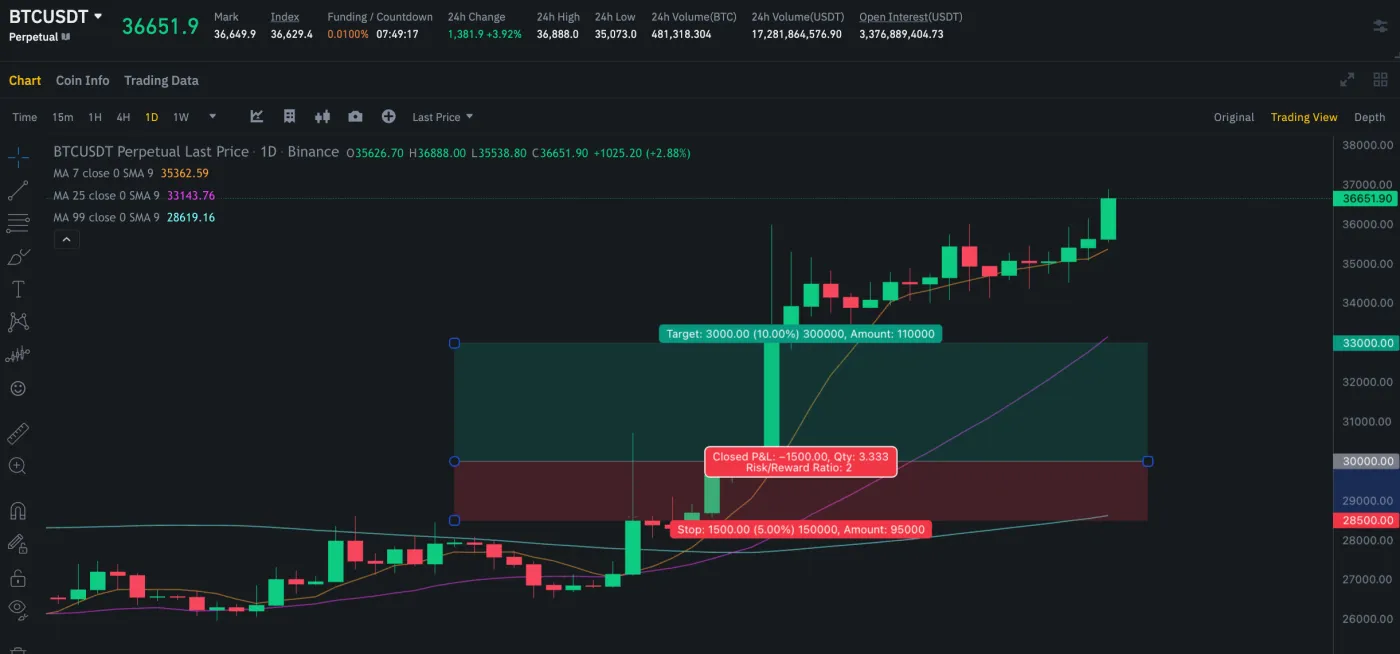
In other words, if the trade succeeds as expected, the trader will have completed the trade with a 1:2 risk/reward ratio. But what does a risk/reward ratio like 1/2 or 0.2 actually mean, and how can you use it in your trading strategy?
Understanding and Using the Risk/Reward Ratio
Put another way, a risk/reward ratio of 1/2 or 0.2 means that the profit you can gain by taking on the risk in that trade is twice as large. In other words, by risking a $100 loss, you can earn $200 in profit. Doesn't sound bad, does it?
So is it always best to aim for a high ratio? What if you could risk a $10 loss to earn $200 in profit? Unfortunately, that kind of situation doesn't come up often. To get it, you'd have to enter with a very tight stop loss, or spot an opportunity with enormous profit potential that few others have noticed.
One important point: the risk/reward ratio isn't about setting a target value and fitting your trade to it. It's a tool for 'judging' the level of risk at the moment you're about to enter. In short, the core of the risk/reward ratio is judging the level of risk in the trade you're about to make and building an accurate trading plan.
Once you properly understand the risk/reward ratio, you can use it together with your average win rate. That way, you can make a profit through a high risk/reward ratio even with a low win rate. Did you know that most successful traders actually have a win rate of only 40%?
 How to Calculate the Optimal Risk-Reward Ratio (You Can Profit Even with a Low Win Rate)4 min read
Using the Risk/Reward Ratio Together with Your Win Rate
The risk/reward ratio is often used together with the win rate. The win rate is calculated from the number of profitable trades against the number of losing trades. For example, a 60% win rate means you make a profit on 60% of your trades on average. So how can you use this together with the risk/reward ratio?
For example, a trader might risk losing $100 to make $700. In this case, the risk/reward ratio is 1:7. But let's say the win rate is very low, only around 20%.
Let's run a simulation. With that risk/reward ratio and win rate, a trader makes 10 trades with $100 each. In this case, the trader can earn $1,400. The win rate is low, but because the risk/reward ratio is very high, the trader makes a sizable profit.
But what if the risk/reward ratio drops and the trader earns only $500 per winning trade? After 10 trades, the trader would break even. In other words, this is the breakeven point, where profits and losses are equal. Putting this together, the minimum win rate this trader needs is 20%, with a risk/reward ratio of 1:5.
As you can see, even with a low win rate, you can make a profit if your risk/reward ratio is high. For example, if you make 10 trades of the same size with a 1:10 risk/reward ratio, even if you fail 9 times, one success is enough to break even. Win just one more time, and you're immediately in profit.
Wrapping Up
So far, we've looked at what the risk/reward ratio is, how to calculate it, and how to use it in trading. Calculating the risk/reward ratio well is essential to managing risk in trading. If you identify the exact risk/reward ratio for each trade and apply it to your own win rate, you can trade while managing risk in a more planned way.