The Difference Between Blockchain and Bitcoin, Explained
4 min read · · Korean original
Contents 5
For people who are just getting into the world of crypto assets, terms like blockchain can be confusing. In fact, one of the questions people ask most often is how blockchain and Bitcoin are different. In this post, I'll explain the differences between blockchain and Bitcoin.
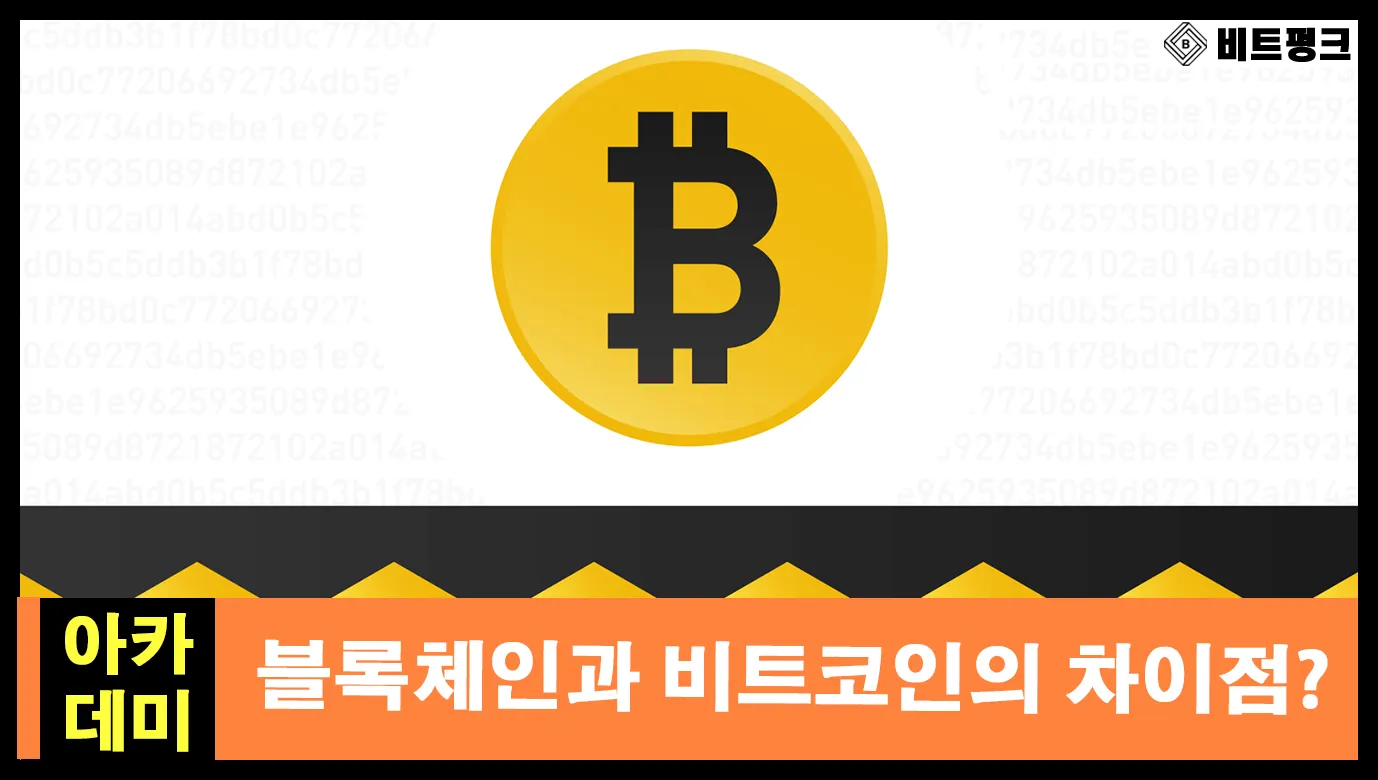
The Difference Between Blockchain and Bitcoin
Let me give you an example. The browser you're using right now to read this post is a 'technology' used to share information online. Chrome is a browser 'product' made by Google, and it has the most users today.
Blockchain works the same way. Blockchain is a 'technology' used to record information. Crypto assets are one way of using blockchain technology. Bitcoin is the first crypto asset 'coin' to use blockchain technology. Does that make a bit more sense now? Let's take a closer look.
A Closer Look at Blockchain
A blockchain is a distributed, decentralized digital ledger. That may sound complicated, but it's simple if you compare it with traditional banks or government agencies. Banks and governments manage their databases in a 'sole' and 'centralized' way. In other words, the Bank of Korea handles the database for its currency on its own. And such a database usually exists as a single copy, or with a few private backups.
A blockchain, on the other hand, is not controlled by any single institution, and everyone who takes part in the network shares a common public ledger. There isn't just one copy of the ledger but many, and they are updated regularly with the latest transactions. Most blockchains are designed in this distributed and decentralized way.
A blockchain is a chain of blocks that are linked and secured through cryptographic proof. Blockchain technology is used to permanently record every transaction of a crypto asset.
'Distributed' and 'decentralized' describe how the ledger is structured and maintained. A distributed system is maintained by the joint work of many users spread across the world. These users are also called network nodes, and every node takes part in checking and validating transactions according to the system's rules. As a result, power is not centralized but distributed.
One reason blockchains are so resistant to tampering and forgery is that blocks are linked and secured through a process of cryptographic proof. To create a new block, network participants have to take part in a mathematical computing activity called mining, and they pay a cost to do so. Miners are responsible for validating transactions, grouping them into newly created blocks, and adding those blocks to the blockchain. As a reward, miners receive new coins.
Does blockchain technology make sense now? To sum up, a blockchain is a chain of linked data blocks that are 1) arranged in chronological order and 2) protected by cryptography, 3) linked together.
A Closer Look at Crypto Assets
Crypto assets are digital forms of money and assets used as a means of exchanging value across a distributed network of users. Unlike the traditional banking system, these transactions can be verified through a public digital ledger (the blockchain) and can take place directly between participants (P2P) without an intermediary.
Not every crypto asset can be mined, but for crypto assets that rely on a proof-of-work mining process, like Bitcoin, the total supply grows at a steady pace. Mining is therefore the only way to create new coins of this kind, which helps prevent the dangerous inflation seen in traditional fiat currencies, where governments control the money supply.
A Closer Look at Bitcoin
Finally, it's time to look at the star of the show: Bitcoin. Bitcoin is the first crypto asset and ranks number one by market capitalization. Bitcoin is the first crypto asset coin to use blockchain technology.
Bitcoin was first launched in 2009 by an anonymous developer known as Satoshi Nakamoto. The core idea was to create an independent, decentralized electronic payment system based on mathematical proof and cryptography.
Like most crypto assets, Bitcoin has a limited supply, which means that once the maximum supply is reached, the system can no longer create new bitcoins. Bitcoin's maximum supply is 21 million coins. If you'd like to buy Bitcoin, you can use Binance, the world's largest exchange.
Wrapping Up
That covers the differences between blockchain and Bitcoin. To sum up, blockchain is the technology that Bitcoin is built on, and it's used by other coins as well. Bitcoin is the first coin launched on top of blockchain technology. If you found this helpful, please tap the heart below and share it widely. Thank you.