What Is a Dusting Attack?
3 min read · · Korean original
Contents 5
A dusting attack is a new type of attack in which hackers and scammers send small amounts of coins to wallets in order to steal users' assets. Through a dusting attack, attackers can track the transaction activity of crypto wallets and analyze related addresses to figure out the identity of the wallet owner.

What Is Dust?
Dust refers to a small amount of coins or tokens. It is such a tiny quantity that most users don't even notice it. In the case of Bitcoin, anything from 1 satoshi (0.00000001 BTC), its smallest unit, up to about 100 satoshis can be called dust. That's an amount worth less than roughly KRW 1.
On crypto exchanges like Binance, dust can also mean the small amount of coins left in a user's account after a trade order is filled. Dust is too small to trade, but you can convert it to BNB.
Technically, dust is defined as a transaction amount that is lower than the transaction fee. For Bitcoin transactions (non-SegWit), this works out to 546 satoshis, and for native SegWit transactions, 294 satoshis. In other words, a transaction of 546 satoshis or less is considered spam and is likely to be rejected by validating nodes.
What Is a Dusting Attack?
A dusting attack is an attack method in which a very small amount of crypto is sent to a large number of addresses, and the transactions are then tracked.
The ultimate goal of a dusting attack is to identify the owners of the targeted wallet addresses, which can then be used for sophisticated phishing and cyberattacks.
Dusting attacks are possible because most crypto activity can be traced on public blockchains.
A dusting attack works by combining and analyzing multiple addresses. If the user moves the dust balance along with other funds, the tracking begins. However, if the dust stays untouched in the wallet, the wallet's activity cannot be tracked.
A Dusting Attack on Binance Chain (Example)
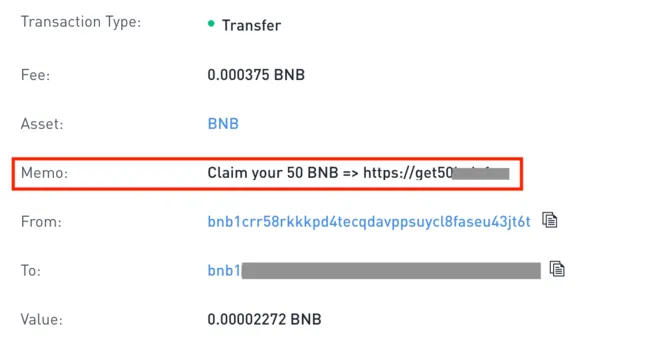
In October 2020, scammers carried out a new kind of dusting attack on Binance Chain. They sent small amounts of BNB to many addresses and left links to malicious websites in the transaction memos.
Blockchain and Anonymity
Because blockchains are open and decentralized, anyone can set up a wallet and join the network without identity verification. Every transaction is recorded publicly, but it isn't always easy to find the identity behind each address or transaction. This is why cryptocurrencies like Bitcoin offer a certain degree of anonymity, but not complete anonymity.
P2P (peer-to-peer) trading takes place without an intermediary, so it is more likely to preserve anonymity. However, P2P exchanges collect personal data through KYC verification, so your identity is not fully anonymous. That said, using a P2P exchange like Pexpay has the advantage that you can get help if something goes wrong.
Beyond dusting attacks, many companies, research institutes, and government agencies are analyzing blockchain networks. To protect your anonymity on the blockchain, it's a good idea to use a personal wallet and create a new wallet for each new payment you make.
Wrapping Up
Blockchains are nearly impossible to hack, but wallets can be stolen. If your private key is leaked, ownership of your wallet can be taken over, and if you mistakenly approve permission to move funds from your wallet, you could lose all of your assets.
That's why you need security know-how to survive in the crypto world. Along with the dusting attacks covered in this post, you should also watch out for other attacks such as ransomware, phishing, and keyloggers. As additional security measures, you can consider installing trusted antivirus software on your devices, encrypting your wallet, and keeping your keys offline.