Margin Trading Explained: How It Works, Benefits and Risks
7 min read · · Korean original
Contents 6
In financial markets, margin is the collateral, or deposit, that an investor must put up with a broker or exchange to show their creditworthiness.
Does that make sense? Put simply, margin trading means borrowing funds from a broker to trade financial assets, and margin (= deposit) is the collateral you leave with the broker when you take out that loan.
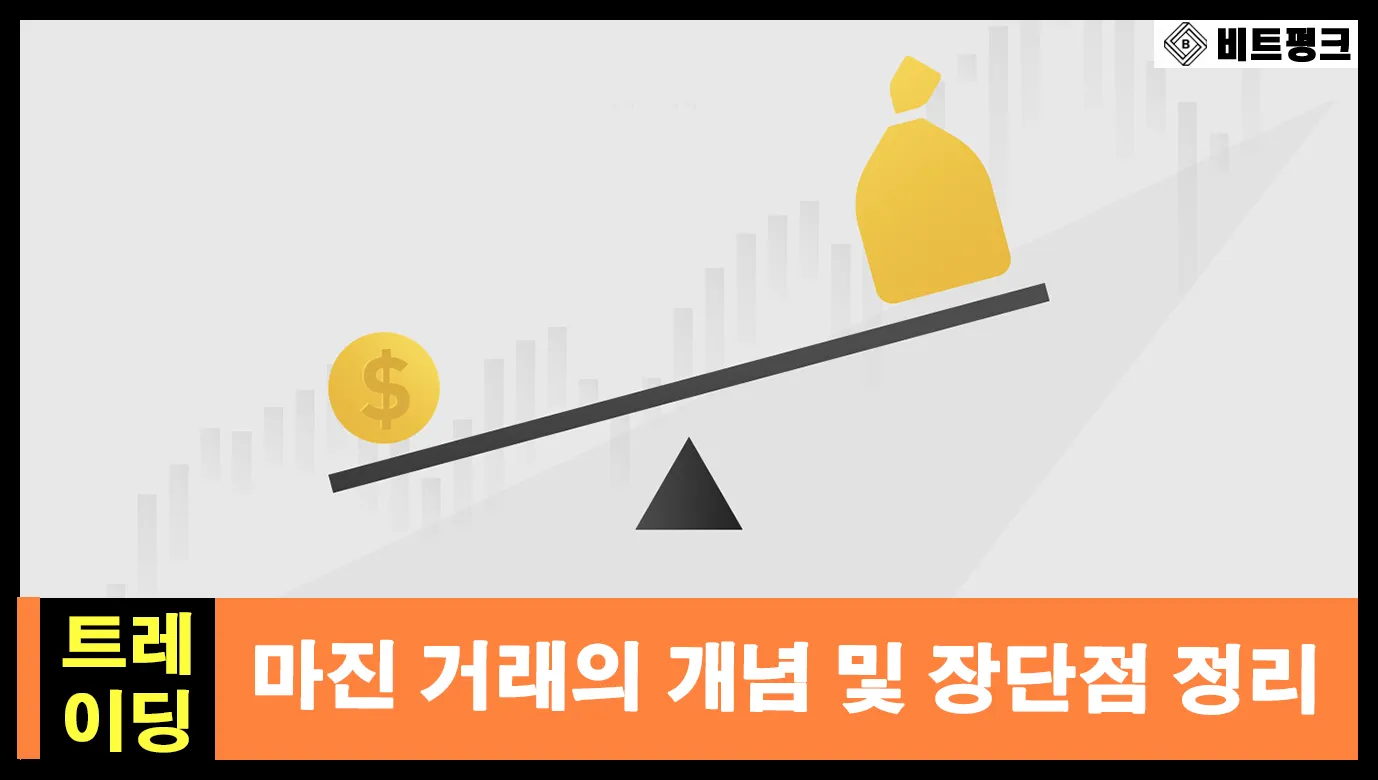
Margin trading is usually used together with leverage. As a result, both profits and losses get bigger. If you take a loss, a margin call may lead the broker to liquidate your collateral and recover the principal.
- Margin trading: A way of trading assets with borrowed funds. It lets you make large trades with little capital.
- Amplified gains and losses: Because of leverage, both profits and losses can swing much more than usual.
- Margin call: If losses in the margin account grow larger than the minimum margin balance, a margin call is triggered and the collateral may be liquidated.
What Is Margin Trading?
Margin trading means borrowing funds from a broker to trade a larger amount than you otherwise could. In other words, margin trading lets you trade more assets than you could with ordinary spot trading.
For example, if a margin account has an initial margin requirement of 60%, you only need $6,000 of your own money: you can borrow $4,000 from the broker and then buy $10,000 worth of securities. This way, you can trade more assets with less money.
In short, margin trading is a way of trading in which you take out a loan from a broker to buy more assets or open larger positions than you normally would.
The U.S. Securities and Exchange Commission has stated that margin trading "can be extremely risky and is not at all suitable for everyone."
How to Trade on Margin
To trade on margin, you need a margin account. A margin account is different from a spot account. In a margin account, you deposit assets and use them as collateral to buy spot or futures assets. Interest is charged on the borrowed margin funds, and these must be repaid later.
Let's look at an example. To make a $100,000 margin trade in Bitcoin with 10x leverage, a trader needs to put up at least $10,000 of capital. They can then trade up to $100,000 worth of Bitcoin using the borrowed funds.
Margin funds can be used for both spot and futures trading. In futures trading, they can be used to open both long and short positions. A long position is a bet that the asset's price will go up, and a short position is a bet that it will go down.
While a margin position is open, the trader's assets serve as collateral. The thing to watch out for is that if losses pile up beyond the collateral, a margin call may be triggered and the position may be forcibly liquidated.
For example, the price may drop sharply while you have a long position open. At that point, you need to top up your margin balance to keep the position open. If you can't, the position you hold may be automatically liquidated to cover the losses.
The 4 Components of a Margin Account
A margin account is made up of four components: minimum margin, initial margin, maintenance margin, and margin call. If you plan to trade on margin, a solid understanding of these concepts is essential.
1. Minimum Margin
Margin trading comes with a minimum margin (deposit). This is the minimum amount needed to start margin trading, usually around $2,000. However, some exchanges set the minimum margin lower, or much higher.
2. Initial Margin
Once you've opened a margin account, you can use your deposit to borrow assets. Initial margin is the amount actually used to borrow money from the broker and buy assets. Initial margin ranges from 10% to 50%, and a higher initial margin ratio means you need more collateral to borrow the same amount.
3. Maintenance Margin
Maintenance margin is the minimum account balance required to keep a margin loan agreement in place. It plays an important role when an investor takes out a loan to buy or sell a particular asset. It usually isn't a problem as long as you're not losing money, but once losses start, your account needs more maintenance margin to cover them.
4. Margin Call
When the maintenance margin amount falls below the required margin amount, the broker issues a margin call asking you to check your maintenance margin. If the trader fails to meet the margin call, the broker can liquidate positions and assets at its discretion and recover the margin funds. It may also charge additional fees for that margin call transaction.
Large-scale margin calls can set off a domino effect in financial markets. When one investor faces a significant margin call, the forced liquidation can drive down the value of securities that other margin traders hold as collateral, creating a risk of cascading margin calls.
Pros and Cons of Margin Trading
1. Pros of Margin Trading
The most obvious advantage of margin trading is that you can open larger positions with the same funds, which means you can earn more profit. In other words, you can open bigger positions, or more positions, with a small amount of investment capital. And when you're in profit, you get the chance to use even more leverage.
2. Cons of Margin Trading
However, the downside of margin trading is that losses can grow just as large. Unlike regular spot trading, margin trading can lead to losses that exceed the trader's initial investment, so it is considered a fairly risky way to trade. Depending on the leverage used, even a small move in the market price can cause huge losses for the trader.
Margin trading also comes with extra costs. Brokers often charge interest, and these fees are charged by default regardless of whether the margin account is in profit or at a loss.
So if you trade on margin, it's important to have a proper risk management strategy in place and to make good use of tools such as limit orders and stop-losses.
| Pros of margin trading | Cons of margin trading |
|---|---|
| Potential for large gains through leverage | Potential for large losses due to leverage |
| Increased buying power | Account fees and interest costs |
| High flexibility in managing funds | Possible need for additional capital due to margin calls |
| More leverage opportunities when collateral value rises | Securities must be sold in a forced liquidation |
Margin Trading in the Crypto Market
Margin trading is inherently riskier than regular trading, but on crypto exchanges the risk is far higher. Because of the extreme volatility unique to the crypto market, margin trading can be especially dangerous for beginners.
Being able to analyze charts, identify trends, spot support and resistance, and calculate position size doesn't remove the risks that come with margin trading, but it can help you trade more effectively.
That's why it's essential to build up enough experience with regular spot trading before you move on to margin and futures trading.
Wrapping Up
Margin trading can be an attractive option for investors seeking potentially high returns. Leveraged trading through a margin account, when used properly, can help improve investment returns and diversify a portfolio.
However, leverage works the same way on losses, which raises the risk. That's why margin trading is suited to experienced traders, and you need to be even more careful when trading on margin in the highly volatile crypto market.
To sum up, margin trading offers high profit potential, but the risks that come with it are just as large, so it's important to understand them well before you dive in.